Showing posts with label ABOUT GODS. Show all posts
Showing posts with label ABOUT GODS. Show all posts
ALLAH - Creator and Sustainer of the universe for muslims

The One true God is a reflection of the unique concept that Islam associates with God. To a Muslim, Allah is the Almighty, Creator and Sustainer of the universe, Who is similar to nothing and nothing is comparable to Him. The Prophet Muhammad was asked by his contemporaries about Allah; the answer came directly from God Himself in the form of a short chapter of the Quran, which is considered the essence of the unity or the motto of monotheism. This is chapter 112 which reads:
"In the name of God, the Merciful, the Compassionate.
Say (O Muhammad) He is God the One God, the Everlasting Refuge, who has not begotten, nor has been begotten, and equal to Him is not anyone."
Some non-Muslims allege that God in Islam is a stern and cruel God who demands to be obeyed fully. He is not loving and kind. Nothing can be farther from truth than this allegation. It is enough to know that, with the exception of one, each of the 114 chapters of the Quran begins with the verse: "In the name of God, the Merciful, the Compassionate." In one of the sayings of Prophet Muhammad (PBUH) we are told that "God is more loving and kinder than a mother to her dear child."
But God is also Just. Hence evildoers and sinners must have their share of punishment and the virtuous, His bounties and favors. Actually God's attribute of Mercy has full manifestation in His attribute of Justice. People suffering throughout their lives for His sake and people oppressing and exploiting other people all their lives should not receive similar treatment from their Lord. Expecting similar treatment for them will amount to negating the very belief in the accountability of man in the Hereafter and thereby negating all the incentives for a moral and virtuous life in this world. The following Quranic verses are very clear and straightforward in this respect:
"Verily, for the Righteous are gardens of Delight, in the Presence of their Lord. Shall We then treat the people of Faith like the people of Sin? What is the matter with you? How judge you?" (68:34-36)
--------------------------------------------------------------------------------
Islam rejects characterizing God in any human form or depicting Him as favoring certain individuals or nations on the basis of wealth, power or race. He created the human beings as equals. They may distinguish themselves and get His favor through virtue and piety only.
The concept that God rested in the seventh day of creation, that God wrestled with one of His soldiers, that God is an envious plotter against mankind, or that God is incarnate in any human being are considered blasphemy from the Islamic point of view.
The unique usage of Allah as a personal name of God is a reflection of Islam's emphasis on the purity of the belief in God which is the essence of the message of all God's messengers. Because of this, Islam considers associating any deity or personality with God as a deadly sin which God will never forgive, despite the fact He may forgive all other sins.
[Note that what is meant above applies ONLY to those people who die in a state wherein they are associating others with God. The repentance of those who yet live is acceptable to God if He wills. - MSA of USC]
The Creator must be of a different nature from the things created because if he is of the same nature as they are, he will be temporal and will therefore need a maker. It follows that nothing is like Him. If the maker is not temporal, then he must be eternal. But if he is eternal, he cannot be caused, and if nothing outside him causes him to continue to exist, which means that he must be self-sufficient. And if the does not depend on anything for the continuance of his own existence, then this existence can have no end. The Creator is therefore eternal and everlasting: "He is the First and the Last."
He is Self-Sufficient or Self-Subsistent or, to use a Quranic term, Al-Qayyum. The Creator does not create only in the sense of bringing things into being, He also preserves them and takes them out of existence and is the ultimate cause of whatever happens to them.
"God is the Creator of everything. He is the guardian over everything. Unto Him belong the keys of the heavens and the earth." (39:62, 63)
"No creature is there crawling on the earth, but its provision rests on God. He knows its lodging place and it repository." (11:6)
God's Attributes
If the Creator is Eternal and Everlasting, then His attributes must also be eternal and everlasting. He should not lose any of His attributes nor acquire new ones. If this is so, then His attributes are absolute. Can there be more than one Creator with such absolute attributes? Can there be for example, two absolutely powerful Creators? A moment's thought shows that this is not feasible.
The Quran summarizes this argument in the following verses:
"God has not taken to Himself any son, nor is there any god with Him: For then each god would have taken of that which he created and some of them would have risen up over others." (23:91)
And Why, were there gods in earth and heaven other than God, they (heaven and earth) would surely go to ruin." (21:22)
The Oneness of God
The Quran reminds us of the falsity of all alleged gods. To the worshippers of man-made objects, it asks:
"Do you worship what you have carved yourself?" (37:95)
"Or have you taken unto you others beside Him to be your protectors, even such as have no power either for good or for harm to themselves?" (13:16)
To the worshippers of heavenly bodies it cites the story of Abraham:
"When night outspread over him he saw a star and said, 'This is my Lord.' But when it set he said, 'I love not the setters.' When he saw the moon rising, he said, 'This is my Lord.' But when it set he said, 'If my Lord does not guide me I shall surely be of the people gone astray.' When he saw the sun rising, he said, 'This is my Lord; this is greater.' But when it set he said, 'O my people, surely I quit that which you associate, I have turned my face to Him Who originated the heavens and the earth; a man of pure faith, I am not of the idolaters.'" (6:76-79)
The Believer's Attitude
In order to be a Muslim, i.e., to surrender oneself to God, it is necessary to believe in the oneness of God, in the sense of His being the only Creator, Preserver, Nourisher, etc. But this belief - later on called "Tawhid Ar-Rububiyyah" - is not enough. Many of the idolaters knew and believed that only the Supreme God could do all this, but that was not enough to make them Muslims. To tawhid ar-rububiyyah one must add tawhid al'uluhiyyah, i.e., one acknowledges the fact that is God alone Who deserves to be worshipped, and thus abstains from worshipping any other thing or being.
Having achieved this knowledge of the one true God, man should constantly have faith in Him, and should allow nothing to induce him to deny truth.
When faith enters a person's heart, it causes certain mental states which result in certain actions. Taken together these mental states and actions are the proof for the true faith. The Prophet said, "Faith is that which resides firmly in the heart and which is proved by deeds." Foremost among those mental states is the feeling of gratitude towards God which could be said to be the essence of 'ibada' (worship).
The feeling of gratitude is so important that a non-believer is called 'kafir' which means 'one who denies a truth' and also 'one who is ungrateful.'
A believer loves, and is grateful to God for the bounties He bestowed upon him, but being aware of the fact that his good deeds, whether mental or physical, are far from being commensurate with Divine favors, he is always anxious lest God should punish him, here or in the Hereafter. He, therefore, fears Him, surrenders himself to Him and serves Him with great humility. One cannot be in such a mental state without being almost all the time mindful of God. Remembering God is thus the life force of faith, without which it fades and withers away.
The Quran tries to promote this feeling of gratitude by repeating the attributes of God very frequently. We find most of these attributes mentioned together in the following verses of the Quran:
"He is God; there is no god but He, He is the Knower of the unseen and the visible; He is the All-Merciful, the All-Compassionate. He is God, there is no God but He. He is the King, the All-Holy, the All-Peace, the Guardian of Faith, the All-Preserver, the All-Mighty, the All-Compeller, the All-Sublime. Glory be to God, above that they associate! He is God the Creator, the Maker, the Shaper. To Him belong the Names Most Beautiful. All that is in the heavens and the earth magnifies Him; He is the All-Mighty, the All-Wise." (59:22-24)
"There is no god but He, the Living, the Everlasting. Slumber seizes Him not, neither sleep; to Him belongs all that is in the heavens and the earth. Who is there that shall intercede with Him save by His leave? He knows what lies before them and what is after them, and they comprehend not anything of His knowledge save such as He wills. His throne comprises the heavens and earth; the preserving of them oppresses Him not; He is the All-High, the All-Glorious." (2:255)
"People of the Book, go not beyond the bounds in your religion, and say not as to God but the truth. The Messiah, Jesus son of Mary, was only the Messenger of God, and His Word that He committed to Mary, and a Spirit from Him. So believe in God and His Messengers, and say not, 'Three.' Refrain; better is it for you. God is only one God. Glory be to Him - (He is) above having a son." (4:171)
Source : III&E Brochure Series; No. 2
(published by The Institute of Islamic Information and Education (III&E))
Buddha - The Great Master
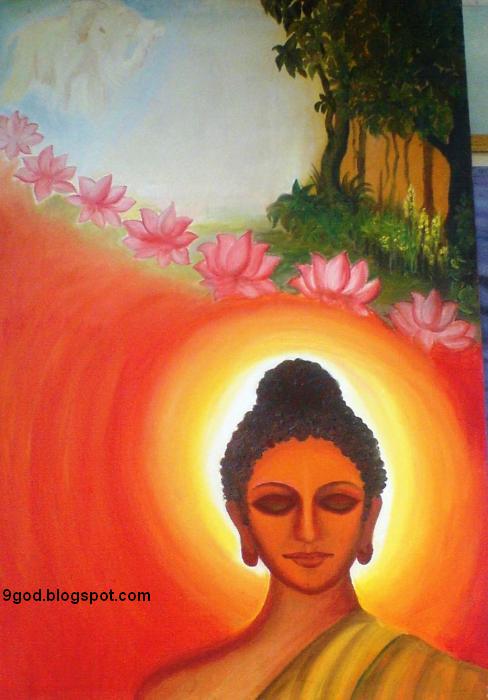
Life Story of Buddha
Buddha was born in the Shakya clan that belonged to the warrior (Kshatriya) caste. His father was Shudhodana and his mother Maya. Before Buddha was born his mother had a dream in which a white elephant descended from heaven and entered her womb. Buddha was said to have been born in a grove named Lumbini near the ancient town of Kapilavastu. At birth the name given to him was Gautama, probably after the more ancient Vedic seer to whom some of the hymns in the Rigveda are ascribed. Buddha was also known as Siddhartha which means 'he whose aim is accomplished' The latter name seems to be a title given to him by his disciples} although varying opinions are held on this issue.
The Prophecy of Buddha
At his birth, a sage is said to have told King Shudhodana that Gautama would grow up to be a powerful king. But to become a king he should be kept away from the sorrows of 1ife. And if perchance he happened to see any of the sorrows of life he would become an universal teacher. Keen as King Shudhodhana was to see Gautama to be a successful ruler, he built up special palace for Gautama from where he could set his eyes on none of the world's sufferings. Even when the prince Gautama went out for stroll or ride, all unpleasant objects were removed so as to prevent Gautama's mind from being disturbed.
The Young Gautama is kept away from Real Life
But the prophesy of Gautama becoming an universal teacher was destined to be fulfilled. One day through some lapse, Gautama managed to s1ip out unnoticed from the palace. Riding through the streets of the city he saw for the first time in his life, a lame person, a sick person, a dead body and an ascetic.
These sights made a deep impact on his tender teenaged mind and he set thinking upon the cause of sufferings and sorrow. Consequently, Gautama began neglecting the affairs of the State which his father had assigned to him. Alarmed at his son's strange behaviour, King Shudhodana, to get his son off this brroding decided to marry him to a princess Yashodhara. Some days after marriage a son was born to them who was named Rahula.
But married life could not distract Gautama from his life's mission for long. When his patience was at the end of its tether, Gautawna decided to forsake family life and one day he slipped out of his palace along with his servant Chandaka. After moving out of the city, Gautema cut off his hair removed his royal ornaments and jewels, his rich garments and sandals and gave them to Chandaka and bid him to return to the palace with the news of his (Gautama's) departure.
Gautama becomes The Buddha - The Enlightened One
Thus Gautama set out on his quest for the cause of sufferings (Klesha). He undertook severe austerities by fasting continuously. In this he was accompanied by five disciples. But his frail and pampered body could not stand up to this self-inflicted punishment and one day he fainted. Realizing that this was not the way to arrive at the truth, he gave up the austerities. Horrified at their Master's apostasy the five disciples left him. But undaunted, Gautama continued his quest for the cause of sufferings. He seated himself under a fig tree (Mahabodhi tree) and decided not get up unless he found answers to his questions. His enlightenment is said to have come suddenly and was exceedingly simple - viz., that all pain is caused - by desire, and therefore peace comes when one ceases to crave for anything. This thought was new at that age and it struck him with blinding force, and not only influenced his future life but left a lasting imprint on Buddhist philosophy. Freedom from all desires was said to release a person from the cycle of re-birth and lead to his salvation (Nirvana).
After this revelation Gautama started preaching to people and for this he travelled from place to place. He is said to have delivered his first sermon at a deer park (Isipatana) setting in motion, the wheel of law (Dharma-chakra or Dhammachakra in Pali).
As his teachings impressed people his following grew. Among his early converts were Sariputta, Mogallana and Ananda. He even received the patronage of rich traders like Anathapindika (i.e. feeder of poor) and powerful kinqs of the age like Ajatashatru of Magadha. After the revelation (Bodhi), Gautama came to be known as Buddha or Gautama Buddha.
He was also known as Shakyamuni (Sage of the Shakyas). The tree under which he attained enlightenment is known as the Bodhi or Mahabodhi tree But though he received an impressive following Buddha never claimed Divine status. Very few miracles are attributed to him.
"Miracles" by the Buddha
On one occasion a grieving lady carried her dead child to Buddha and asked him to revive it. This was a perfect setting for a miracle to be woven into religious folklore, but Buddhist records state that Buddha calmed the lady and told her that he would require three mustard seeds to revive her child. But the mustard seeds should be from a family where so far no one has ever died. To fulfill this seemingly simple request the lady went from house to house only to be told that sometime or the other, someone had died in every family. Gradually, the truth dawned upon the grieving lady and going to a cemetery, she laid down her child's body and taking its little hand in hers, she said "Beloved son, I thought that death has overtaken you alone. but no it overtakes all of us". She went back to Buddha and became his disciple.
SRI GURU NANAK DEV JI

Sri Guru Nanak Dev ji was born in 1469 in Talwandi, a village in the Sheikhupura district, 65 kms. west of Lahore. His father was a village official in the local revenue administration. As a boy, Sri Guru Nanak learnt, besides the regional languages, Persian and Arabic. He was married in 1487 and was blessed with two sons, one in 1491 and the second in 1496. In 1485 he took up, at the instance of his brother-in-law, the appointment of an official in charge of the stores of Daulat Khan Lodhi, the Muslim ruler of the area at Sultanpur. It is there that he came into contact with Mardana, a Muslim minstrel (Mirasi) who was senior in age.
By all accounts, 1496 was the year of his enlightenment when he started on his mission. His first statement after his prophetic communion with God was "There is no Hindu, nor any Mussalman." This is an announcement of supreme significance it declared not only the brotherhood of man and the fatherhood of God, but also his clear and primary interest not in any metaphysical doctrine but only in man and his fate. It means love your neighbour as yourself. In addition, it emphasised, simultaneously the inalienable spirituo-moral combination of his message. Accompanied by Mardana, he began his missionary tours. Apart from conveying his message and rendering help to the weak, he forcefully preached, both by precept and practice, against caste distinctions ritualism, idol worship and the pseudo-religious beliefs that had no spiritual content. He chose to mix with all. He dined and lived with men of the lowest castes and classes Considering the then prevailing cultural practices and traditions, this was something socially and religiously unheard of in those days of rigid Hindu caste system sanctioned by the scriptures and the religiously approved notions of untouchability and pollution. It is a matter of great significance that at the very beginning of his mission, the Guru's first companion was a low caste Muslim. The offerings he received during his tours, were distributed among the poor. Any surplus collected was given to his hosts to maintain a common kitchen, where all could sit and eat together without any distinction of caste and status. This institution of common kitchen or langar became a major instrument of helping the poor, and a nucleus for religious gatherings of his society and of establishing the basic equality of all castes, classes and sexes.
When Guru Nanak Dev ji were 12 years old his father gave him twenty rupees and asked him to do a business, apparently to teach him business. Guru Nanak dev ji bought food for all the money and distributed among saints, and poor. When his father asked him what happened to business? He replied that he had done a "True business" at the place where Guru Nanak dev had fed the poor, this gurdwara was made and named Sacha Sauda.
Despite the hazards of travel in those times, he performed five long tours all over the country and even outside it. He visited most of the known religious places and centres of worship. At one time he preferred to dine at the place of a low caste artisan, Bhai Lallo, instead of accepting the invitation of a high caste rich landlord, Malik Bhago, because the latter lived by exploitation of the poor and the former earned his bread by the sweat of his brow. This incident has been depicted by a symbolic representation of the reason for his preference. Sri Guru Nanak pressed in one hand the coarse loaf of bread from Lallo's hut and in the other the food from Bhago's house. Milk gushed forth from the loaf of Lallo's and blood from the delicacies of Bhago. This prescription for honest work and living and the condemnation of exploitation, coupled with the Guru's dictum that "riches cannot be gathered without sin and evil means," have, from the very beginning, continued to be the basic moral tenet with the Sikh mystics and the Sikh society.
During his tours, he visited numerous places of Hindu and Muslim worship. He explained and exposed through his preachings the incongruities and fruitlessness of ritualistic and ascetic practices. At Hardwar, when he found people throwing Ganges water towards the sun in the east as oblations to their ancestors in heaven, he started, as a measure of correction, throwing the water towards the West, in the direction of his fields in the Punjab. When ridiculed about his folly, he replied, "If Ganges water will reach your ancestors in heaven, why should the water I throw up not reach my fields in the Punjab, which are far less distant ?"
He spent twenty five years of his life preaching from place to place. Many of his hymns were composed during this period. They represent answers to the major religious and social problems of the day and cogent responses to the situations and incidents that he came across. Some of the hymns convey dialogues with Yogis in the Punjab and elsewhere. He denounced their methods of living and their religious views. During these tours he studied other religious systems like Hinduism, Jainism, Buddhism and Islam. At the same time, he preached the doctrines of his new religion and mission at the places and centres he visited. Since his mystic system almost completely reversed the trends, principles and practices of the then prevailing religions, he criticised and rejected virtually all the old beliefs, rituals and harmful practices existing in the country. This explains the necessity of his long and arduous tours and the variety and profusion of his hymns on all the religious, social, political and theological issues, practices and institutions of his period.
Finally, on the completion of his tours, he settled as a peasant farmer at Kartarpur, a village in the Punjab. Bhai Gurdas, the scribe of Guru Granth Sahib, was a devout and close associate of the third and the three subsequent Gurus. He was born 12 years after Guru Nanak's death and joined the Sikh mission in his very boyhood. He became the chief missionary agent of the Gurus. Because of his intimate knowledge of the Sikh society and his being a near contemporary of Sri Guru Nanak, his writings are historically authentic and reliable. He writes that at Kartarpur Guru Nanak donned the robes of a peasant and continued his ministry. He organised Sikh societies at places he visited with their meeting places called Dharamsalas. A similar society was created at Kartarpur. In the morning, Japji was sung in the congregation. In the evening Sodar and Arti were recited. The Guru cultivated his lands and also continued with his mission and preachings. His followers throughout the country were known as Nanak-panthies or Sikhs. The places where Sikh congregation and religious gatherings of his followers were held were called Dharamsalas. These were also the places for feeding the poor. Eventually, every Sikh home became a Dharamsala.
One thing is very evident. Guru Nanak had a distinct sense of his prophethood and that his mission was God-ordained. During his preachings, he himself announced. "O Lallo, as the words of the Lord come to me, so do I express them." Successors of Guru Nanak have also made similar statements indicating that they were the messengers of God. So often Guru Nanak refers to God as his Enlightener and Teacher. His statements clearly show his belief that God had commanded him to preach an entirely new religion, the central idea of which was the brotherhood of man and the fatherhood of God, shorn of all ritualism and priestcraft. During a dialogue with the Yogis, he stated that his mission was to help everyone. He came to be called a Guru in his lifetime. In Punjabi, the word Guru means both God and an enlightener or a prophet. During his life, his disciples were formed and came to be recognised as a separate community. He was accepted as a new religious prophet. His followers adopted a separate way of greeting each other with the words Sat Kartar (God is true). Twentyfive years of his extensive preparatory tours and preachings across the length and breadth of the country clearly show his deep conviction that the people needed a new prophetic message which God had commanded him to deliver. He chose his successor and in his own life time established him as the future Guru or enlightener of the new community. This step is of the greatest significance, showing Guru Nanak s determination and declaration that the mission which he had started and the community he had created were distinct and should be continued, promoted and developed. By the formal ceremony of appointing his successor and by giving him a new name, Angad (his part or limb), he laid down the clear principle of impersonality, unity and indivisibility of Guruship. At that time he addressed Angad by saying, Between thou and me there is now no difference. In Guru Granth Sahib there is clear acceptance and proclamation of this identity of personality in the hymns of Satta-Balwand. This unity of spiritual personality of all the Gurus has a theological and mystic implication. It is also endorsed by the fact that each of the subsequent Gurus calls himself Nanak in his hymns. Never do they call themselves by their own names as was done by other Bhagats and Illyslics. That Guru Nanak attached the highest importance to his mission is also evident from his selection of the successor by a system of test, and only when he was found perfect, was Guru Angad appointed as his successor. He was comparatively a new comer to the fold, and yet he was chosen in preference to the Guru's own son, Sri Chand, who also had the reputation of being a pious person, and Baba Budha, a devout Sikh of long standing, who during his own lifetime had the distinction of ceremonially installing all subsequent Gurus.
All these facts indicate that Guru Nanak had a clear plan and vision that his mission was to be continued as an independent and distinct spiritual system on the lines laid down by him, and that, in the context of the country, there was a clear need for the organisation of such a spiritual mission and society. In his own lifetime, he distinctly determined its direction and laid the foundations of some of the new religious institutions. In addition, he created the basis for the extension and organisation of his community and religion.
The above in brief is the story of the Guru's life. We shall now note the chief features of his work, how they arose from his message and how he proceeded to develop them during his lifetime.
(1) After his enlightenment, the first words of Guru Nanak declared the brotherhood of man. This principle formed the foundation of his new spiritual gospel. It involved a fundamental doctrinal change because moral life received the sole spiritual recognition and status. This was something entirely opposed to the religious systems in vogue in the country during the time of the Guru. All those systems were, by and large, other-worldly. As against it, the Guru by his new message brought God on earth. For the first time in the country, he made a declaration that God was deeply involved and interested in the affairs of man and the world which was real and worth living in. Having taken the first step by the proclamation of his radical message, his obvious concern was to adopt further measures to implement the same.
(2)The Guru realised that in the context and climate of the country, especially because of the then existing religious systems and the prevailing prejudices, there would be resistance to his message, which, in view of his very thesis, he wanted to convey to all. He, therefore, refused to remain at Sultanpur and preach his gospel from there. Having declared the sanctity of life, his second major step was in the planning and organisation of institutions that would spread his message. As such, his twentyfive years of extensive touring can be understood only as a major organizational step. These tours were not casual. They had a triple object. He wanted to acquaint himself with all the centres and organisations of the prevalent religious systems so as to assess the forces his mission had to contend with, and to find out the institutions that he could use in the aid of his own system. Secondly, he wanted to convey his gospel at the very centres of the old systems and point out the futile and harmful nature of their methods and practices. It is for this purpose that he visited Hardwar, Kurukshetra, Banaras, Kanshi, Maya, Ceylon, Baghdad, Mecca, etc. Simultaneously, he desired to organise all his followers and set up for them local centres for their gatherings and worship. The existence of some of these far-flung centres even up-till today is a testimony to his initiative in the Organizational and the societal field. His hymns became the sole guide and the scripture for his flock and were sung at the Dharamsalas.
(3) Guru Nanak's gospel was for all men. He proclaimed their equality in all respects. In his system, the householder's life became the primary forum of religious activity. Human life was not a burden but a privilege. His was not a concession to the laity. In fact, the normal life became the medium of spiritual training and expression. The entire discipline and institutions of the Gurus can be appreciated only if one understands that, by the very logic of Guru Nanak's system, the householder's life became essential for the seeker. On reaching Kartarpur after his tours, the Guru sent for the members of his family and lived there with them for the remaining eighteen years of his life. For the same reason his followers all over the country were not recluses. They were ordinary men, living at their own homes and pursuing their normal vocations. The Guru's system involved morning and evening prayers. Congregational gatherings of the local followers were also held at their respective Dharamsalas.
(4) After he returned to Kartarpur, Guru Nanak did not rest. He straightaway took up work as a cultivator of land, without interrupting his discourses and morning and evening prayers. It is very significant that throughout the later eighteen years of his mission he continued to work as a peasant. It was a total involvement in the moral and productive life of the community. His life was a model for others to follow. Like him all his disciples were regular workers who had not given up their normal vocations Even while he was performing the important duties of organising a new religion, he nester shirked the full-time duties of a small cultivator. By his personal example he showed that the leading of a normal man's working life was fundamental to his spiritual system Even a seemingly small departure from this basic tenet would have been misunderstood and misconstrued both by his own followers and others. In the Guru's system, idleness became a vice and engagement in productive and constructive work a virtue. It was Guru Nanak who chastised ascetics as idlers and condemned their practice of begging for food at the doors of the householders.
(5) According to the Guru, moral life was the sole medium of spiritual progress In those times, caste, religious and social distinctions, and the idea of pollution were major problems. Unfortunately, these distinctions had received religious sanction The problem of poverty and food was another moral challenge. The institution of langar had a twin purpose. As every one sat and ate at the same place and shared the same food, it cut at the root of the evil of caste, class and religious distinctions. Besides, it demolished the idea of pollution of food by the mere presence of an untouchable. Secondlys it provided food to the needy. This institution of langar and pangat was started by the Guru among all his followers wherever they had been organised. It became an integral part of the moral life of the Sikhs. Considering that a large number of his followers were of low caste and poor members of society, he, from the very start, made it clear that persons who wanted to maintain caste and class distinctions had no place in his system In fact, the twin duties of sharing one's income with the poor and doing away with social distinctions were the two obligations which every Sikh had to discharge. On this score, he left no option to anyone, since he started his mission with Mardana, a low caste Muslim, as his life long companion.
(6) The greatest departure Guru Nanak made was to prescribe for the religious man the responsibility of confronting evil and oppression. It was he who said that God destroys 'the evil doers' and 'the demonical; and that such being God s nature and will, it is man's goal to carry out that will. Since there are evil doers in life, it is the spiritual duty of the seeker and his society to resist evil and injustice. Again, it is Guru Nanak who protests and complains that Babur had been committing tyranny against the weak and the innocent. Having laid the principle and the doctrine, it was again he who proceeded to organise a society. because political and societal oppression cannot be resisted by individuals, the same can be confronted only by a committed society. It was, therefore, he who proceeded to create a society and appointed a successor with the clear instructions to develop his Panth. Again, it was Guru Nanak who emphasized that life is a game of love, and once on that path one should not shirk laying down one's life. Love of one's brother or neighbour also implies, if love is true, his or her protection from attack, injustice and tyranny. Hence, the necessity of creating a religious society that can discharge this spiritual obligation. Ihis is the rationale of Guru Nanak's system and the development of the Sikh society which he organised.
(7) The Guru expressed all his teachings in Punjabi, the spoken language of Northern India. It was a clear indication of his desire not to address the elite alone but the masses as well. It is recorded that the Sikhs had no regard for Sanskrit, which was the sole scriptural language of the Hindus. Both these facts lead to important inferences. They reiterate that the Guru's message was for all. It was not for the few who, because of their personal aptitude, should feel drawn to a life of a so-called spiritual meditation and contemplation. Nor was it an exclusive spiritual system divorced from the normal life. In addition, it stressed that the Guru's message was entirely new and was completely embodied in his hymns. His disciples used his hymns as their sole guide for all their moral, religious and spiritual purposes. I hirdly, the disregard of the Sikhs for Sanskrit strongly suggests that not only was the Guru's message independent and self-contained, without reference and resort to the Sanskrit scriptures and literature, but also that the Guru made a deliberate attempt to cut off his disciples completely from all the traditional sources and the priestly class. Otherwise, the old concepts, ritualistic practices, modes of worship and orthodox religions were bound to affect adversely the growth of his religion which had wholly a different basis and direction and demanded an entirely new approach.
The following hymn from Guru Nanak and the subsequent one from Sankara are contrast in their approach to the world.
"the sun and moon, O Lord, are Thy lamps; the firmament Thy salver; the orbs of the stars the pearls encased in it.
The perfume of the sandal is Thine incense, the wind is Thy fan, all the forests are Thy flowers, O Lord of light.
What worship is this, O Thou destroyer of birth ? Unbeaten strains of ecstasy are the trumpets of Thy worship.
Thou has a thousand eyes and yet not one eye; Thou host a thousand forms and yet not one form;
Thou hast a thousand stainless feet and yet not one foot; Thou hast a thousand organs of smell and yet not one organ. I am fascinated by this play of 'l hine.
The light which is in everything is Chine, O Lord of light.
From its brilliancy everything is illuminated;
By the Guru's teaching the light becometh manifest.
What pleaseth Thee is the real worship.
O God, my mind is fascinated with Thy lotus feet as the bumble-bee with the flower; night and day I thirst for them.
Give the water of Thy favour to the Sarang (bird) Nanak, so that he may dwell in Thy Name."3
Sankara writes: "I am not a combination of the five perishable elements I arn neither body, the senses, nor what is in the body (antar-anga: i e., the mind). I am not the ego-function: I am not the group of the vital breathforces; I am not intuitive intelligence (buddhi). Far from wife and son am 1, far from land and wealth and other notions of that kind. I am the Witness, the Eternal, the Inner Self, the Blissful One (sivoham; suggesting also, 'I am Siva')."
"Owing to ignorance of the rope the rope appears to be a snake; owing to ignorance of the Self the transient state arises of the individualized, limited, phenomenal aspect of the Self. The rope becomes a rope when the false impression disappears because of the statement of some credible person; because of the statement of my teacher I am not an individual life-monad (yivo-naham), I am the Blissful One (sivo-ham )."
"I am not the born; how can there be either birth or death for me ?"
"I am not the vital air; how can there be either hunger or thirst for me ?"
"I am not the mind, the organ of thought and feeling; how can there be either sorrow or delusion for me ?"
"I am not the doer; how can there be either bondage or release for me ?"
"I am neither male nor female, nor am I sexless. I am the Peaceful One, whose form is self-effulgent, powerful radiance. I am neither a child, a young man, nor an ancient; nor am I of any caste. I do not belong to one of the four lifestages. I am the Blessed-Peaceful One, who is the only Cause of the origin and dissolution of the world."4
While Guru Nanak is bewitched by the beauty of His creation and sees in the panorama of nature a lovely scene of the worshipful adoration of the Lord, Sankara in his hymn rejects the reality of the world and treats himself as the Sole Reality. Zimmer feels that "Such holy megalomania goes past the bounds of sense. With Sankara, the grandeur of the supreme human experience becomes intellectualized and reveals its inhuman sterility."5
No wonder that Guru Nanak found the traditional religions and concepts as of no use for his purpose. He calculatedly tried to wean away his people from them. For Guru Nanak, religion did not consist in a 'patched coat or besmearing oneself with ashes"6 but in treating all as equals. For him the service of man is supreme and that alone wins a place in God's heart.
By this time it should be easy to discern that all the eight features of the Guru's system are integrally connected. In fact, one flows from the other and all follow from the basic tenet of his spiritual system, viz., the fatherhood of God and the brotherhood of man. For Guru Nanak, life and human beings became the sole field of his work. Thus arose the spiritual necessity of a normal life and work and the identity of moral and spiritual functioning and growth.
Having accepted the primacy of moral life and its spiritual validity, the Guru proceeded to identify the chief moral problems of his time. These were caste and class distinctions, the institutions, of property and wealth, and poverty and scarcity of food. Immoral institutions could be substituted and replaced only by the setting up of rival institutions. Guru Nanak believed that while it is essential to elevate man internally, it is equally necessary to uplift the fallen and the downtrodden in actual life. Because, the ultimate test of one's spiritual progress is the kind of moral life one leads in the social field. The Guru not only accepted the necessity of affecting change in the environment, but also endeavoured to build new institutions. We shall find that these eight basic principles of the spirituo-moral life enunciated by Guru Nanak, were strictly carried out by his successors. As envisaged by the first prophet, his successors further extended the structure and organised the institutions of which the foundations had been laid by Guru Nanak. Though we shall consider these points while dealing with the lives of the other nine Gurus, some of them need to be mentioned here.
The primacy of the householder's life was maintained. Everyone of the Gurus, excepting Guru Harkishan who died at an early age, was a married person who maintained a family. When Guru Nanak, sent Guru Angad from Kartarpur to Khadur Sahib to start his mission there, he advised him to send for the members of his family and live a normal life. According to Bhalla,8 when Guru Nanak went to visit Guru Angad at Khadur Sahib, he found him living a life of withdrawal and meditation. Guru Nanak directed him to be active as he had to fulfill his mission and organise a community inspired by his religious principles.
Work in life, both for earning the livelihood and serving the common good, continued to be the fundamental tenet of Sikhism. There is a clear record that everyone upto the Fifth Guru (and probably subsequent Gurus too) earned his livelihood by a separate vocation and contributed his surplus to the institution of langar Each Sikh was made to accept his social responsibility. So much so that Guru Angad and finally Guru Amar Das clearly ordered that Udasis, persons living a celibate and ascetic life without any productive vocation, should remain excluded from the Sikh fold. As against it, any worker or a householder without distinction of class or caste could become a Sikh. This indicates how these two principles were deemed fundamental to the mystic system of Guru Nanak. It was defined and laid down that in Sikhism a normal productive and moral life could alone be the basis of spiritual progress. Here, by the very rationale of the mystic path, no one who was not following a normal life could be fruitfully included.
The organization of moral life and institutions, of which the foundations had been laid by Guru Nanak, came to be the chief concern of the other Gurus. We refer to the sociopolitical martyrdoms of two of the Gurus and the organisation of the military struggle by the Sixth Guru and his successors. Here it would be pertinent to mention Bhai Gurdas's narration of Guru Nanak's encounter and dialogue with the Nath Yogis who were living an ascetic life of retreat in the remote hills. They asked Guru Nanak how the world below in the plains was faring. ' How could it be well", replied Guru Nanak, "when the so- called pious men had resorted to the seclusion of the hills ?" The Naths commented that it was incongruous and self-contradictory for Guru Nanak to be a householder and also pretend to lead a spiritual life. That, they said, was like putting acid in milk and thereby destroying its purity. The Guru replied emphatically that the Naths were ignorant of even the basic elements of spiritual life.9 This authentic record of the dialouge reveals the then prevailing religious thought in the country. It points to the clear and deliberate break the Guru made from the traditional system.
While Guru Nanak was catholic in his criticism of other religions, he was unsparing where he felt it necessary to clarify an issue or to keep his flock away from a wrong practice or prejudice. He categorically attacked all the evil institutions of his time including oppression and barbarity in the political field, corruption among the officialss and hypocrisy and greed in the priestly class. He deprecated the degrading practices of inequality in the social field. He criticised and repudiated the scriptures that sanctioned such practices. After having denounced all of them, he took tangible steps to create a society that accepted the religious responsibility of eliminating these evils from the new institutions created by him and of attacking the evil practices and institutions in the Social and political fields. T his was a fundamental institutional change with the largest dimensions and implications for the future of the community and the country. The very fact that originally poorer classes were attracted to the Gurus, fold shows that they found there a society and a place where they could breathe freely and live with a sense of equality and dignity.
Dr H.R. Gupta, the well-known historian, writes, "Nanak's religion consisted in the love of God, love of man and love of godly living. His religion was above the limits of caste, creed and country. He gave his love to all, Hindus, Muslims, Indians and foreigners alike. His religion was a people's movement based on modern conceptions of secularism and socialism, a common brotherhood of all human beings. Like Rousseau, Nanak felt 250 years earlier that it was the common people who made up the human race Ihey had always toiled and tussled for princes, priests and politicians. What did not concern the common people was hardly worth considering. Nanak's work to begin with assumed the form of an agrarian movement. His teachings were purely in Puniabi language mostly spoken by cultivators. Obey appealed to the downtrodden and the oppressed peasants and petty traders as they were ground down between the two mill stones of Government tyranny and the new Muslims' brutality. Nanak's faith was simple and sublime. It was the life lived. His religion was not a system of philosophy like Hinduism. It was a discipline, a way of life, a force, which connected one Sikh with another as well as with the Guru."'° "In Nanak s time Indian society was based on caste and was divided into countless watertight Compartments. Men were considered high and low on account of their birth and not according to their deeds. Equality of human beings was a dream. There was no spirit of national unity except feelings of community fellowship. In Nanak's views men's love of God was the criterion to judge whether a person was good or bad, high or low. As the caste system was not based on divine love, he condemned it. Nanak aimed at creating a casteless and classless society similar to the modern type of socialist society in which all were equal and where one member did not exploit the other. Nanak insisted that every Sikh house should serve as a place of love and devotion, a true guest house (Sach dharamshala). Every Sikh was enjoined to welcome a traveller or a needy person and to share his meals and other comforts with him. "Guru Nanak aimed at uplifting the individual as well as building a nation."
Considering the religious conditions and the philosophies of the time and the social and political milieu in which Guru Nanak was born, the new spirituo- moral thesis he introduced and the changes he brought about in the social and spiritual field were indeed radical and revolutionary. Earlier, release from the bondage of the world was sought as the goal. The householder's life was considered an impediment and an entanglement to be avoided by seclusion, monasticism, celibacy, sanyasa or vanpraslha. In contrast, in the Guru's system the world became the arena of spiritual endeavour. A normal life and moral and righteous deeds became the fundamental means of spiritual progress, since these alone were approved by God. Man was free to choose between the good and the bad and shape his own future by choosing virtue and fighting evil. All this gave "new hope, new faith, new life and new expectations to the depressed, dejected and downcast people of Punjab."
Guru Nanak's religious concepts and system were entirely opposed to those of the traditional religions in the country. His views were different even from those of the saints of the Radical Bhakti movement. From the very beginning of his mission, he started implementing his doctrines and creating institutions for their practice and development. In his time the religious energy and zeal were flowing away from the empirical world into the desert of otherworldliness, asceticism and renunciation. It was Guru Nanak's mission and achievement not only to dam that Amazon of moral and spiritual energy but also to divert it into the world so as to enrich the moral, social the political life of man. We wonder if, in the context of his times, anything could be more astounding and miraculous. The task was undertaken with a faith, confidence and determination which could only be prophetic.
It is indeed the emphatic manifestation of his spiritual system into the moral formations and institutions that created a casteless society of people who mixed freely, worked and earned righteously, contributed some of their income to the common causes and the langar. It was this community, with all kinds of its shackles broken and a new freedom gained, that bound its members with a new sense of cohesion, enabling it to rise triumphant even though subjected to the severest of political and military persecutions.
The life of Guru Nanak shows that the only interpretation of his thesis and doctrines could be the one which we have accepted. He expressed his doctrines through the medium of activities. He himself laid the firm foundations of institutions and trends which flowered and fructified later on. As we do not find a trace of those ideas and institutions in the religious milieu of his time or the religious history of the country, the entirely original and new character of his spiritual system could have only been mystically and prophetically inspired.
Apart from the continuation, consolidation and expansion of Guru Nanak's mission, the account that follows seeks to present the major contributions made by the remaining Gurus.
By all accounts, 1496 was the year of his enlightenment when he started on his mission. His first statement after his prophetic communion with God was "There is no Hindu, nor any Mussalman." This is an announcement of supreme significance it declared not only the brotherhood of man and the fatherhood of God, but also his clear and primary interest not in any metaphysical doctrine but only in man and his fate. It means love your neighbour as yourself. In addition, it emphasised, simultaneously the inalienable spirituo-moral combination of his message. Accompanied by Mardana, he began his missionary tours. Apart from conveying his message and rendering help to the weak, he forcefully preached, both by precept and practice, against caste distinctions ritualism, idol worship and the pseudo-religious beliefs that had no spiritual content. He chose to mix with all. He dined and lived with men of the lowest castes and classes Considering the then prevailing cultural practices and traditions, this was something socially and religiously unheard of in those days of rigid Hindu caste system sanctioned by the scriptures and the religiously approved notions of untouchability and pollution. It is a matter of great significance that at the very beginning of his mission, the Guru's first companion was a low caste Muslim. The offerings he received during his tours, were distributed among the poor. Any surplus collected was given to his hosts to maintain a common kitchen, where all could sit and eat together without any distinction of caste and status. This institution of common kitchen or langar became a major instrument of helping the poor, and a nucleus for religious gatherings of his society and of establishing the basic equality of all castes, classes and sexes.
When Guru Nanak Dev ji were 12 years old his father gave him twenty rupees and asked him to do a business, apparently to teach him business. Guru Nanak dev ji bought food for all the money and distributed among saints, and poor. When his father asked him what happened to business? He replied that he had done a "True business" at the place where Guru Nanak dev had fed the poor, this gurdwara was made and named Sacha Sauda.
Despite the hazards of travel in those times, he performed five long tours all over the country and even outside it. He visited most of the known religious places and centres of worship. At one time he preferred to dine at the place of a low caste artisan, Bhai Lallo, instead of accepting the invitation of a high caste rich landlord, Malik Bhago, because the latter lived by exploitation of the poor and the former earned his bread by the sweat of his brow. This incident has been depicted by a symbolic representation of the reason for his preference. Sri Guru Nanak pressed in one hand the coarse loaf of bread from Lallo's hut and in the other the food from Bhago's house. Milk gushed forth from the loaf of Lallo's and blood from the delicacies of Bhago. This prescription for honest work and living and the condemnation of exploitation, coupled with the Guru's dictum that "riches cannot be gathered without sin and evil means," have, from the very beginning, continued to be the basic moral tenet with the Sikh mystics and the Sikh society.
During his tours, he visited numerous places of Hindu and Muslim worship. He explained and exposed through his preachings the incongruities and fruitlessness of ritualistic and ascetic practices. At Hardwar, when he found people throwing Ganges water towards the sun in the east as oblations to their ancestors in heaven, he started, as a measure of correction, throwing the water towards the West, in the direction of his fields in the Punjab. When ridiculed about his folly, he replied, "If Ganges water will reach your ancestors in heaven, why should the water I throw up not reach my fields in the Punjab, which are far less distant ?"
He spent twenty five years of his life preaching from place to place. Many of his hymns were composed during this period. They represent answers to the major religious and social problems of the day and cogent responses to the situations and incidents that he came across. Some of the hymns convey dialogues with Yogis in the Punjab and elsewhere. He denounced their methods of living and their religious views. During these tours he studied other religious systems like Hinduism, Jainism, Buddhism and Islam. At the same time, he preached the doctrines of his new religion and mission at the places and centres he visited. Since his mystic system almost completely reversed the trends, principles and practices of the then prevailing religions, he criticised and rejected virtually all the old beliefs, rituals and harmful practices existing in the country. This explains the necessity of his long and arduous tours and the variety and profusion of his hymns on all the religious, social, political and theological issues, practices and institutions of his period.
Finally, on the completion of his tours, he settled as a peasant farmer at Kartarpur, a village in the Punjab. Bhai Gurdas, the scribe of Guru Granth Sahib, was a devout and close associate of the third and the three subsequent Gurus. He was born 12 years after Guru Nanak's death and joined the Sikh mission in his very boyhood. He became the chief missionary agent of the Gurus. Because of his intimate knowledge of the Sikh society and his being a near contemporary of Sri Guru Nanak, his writings are historically authentic and reliable. He writes that at Kartarpur Guru Nanak donned the robes of a peasant and continued his ministry. He organised Sikh societies at places he visited with their meeting places called Dharamsalas. A similar society was created at Kartarpur. In the morning, Japji was sung in the congregation. In the evening Sodar and Arti were recited. The Guru cultivated his lands and also continued with his mission and preachings. His followers throughout the country were known as Nanak-panthies or Sikhs. The places where Sikh congregation and religious gatherings of his followers were held were called Dharamsalas. These were also the places for feeding the poor. Eventually, every Sikh home became a Dharamsala.
One thing is very evident. Guru Nanak had a distinct sense of his prophethood and that his mission was God-ordained. During his preachings, he himself announced. "O Lallo, as the words of the Lord come to me, so do I express them." Successors of Guru Nanak have also made similar statements indicating that they were the messengers of God. So often Guru Nanak refers to God as his Enlightener and Teacher. His statements clearly show his belief that God had commanded him to preach an entirely new religion, the central idea of which was the brotherhood of man and the fatherhood of God, shorn of all ritualism and priestcraft. During a dialogue with the Yogis, he stated that his mission was to help everyone. He came to be called a Guru in his lifetime. In Punjabi, the word Guru means both God and an enlightener or a prophet. During his life, his disciples were formed and came to be recognised as a separate community. He was accepted as a new religious prophet. His followers adopted a separate way of greeting each other with the words Sat Kartar (God is true). Twentyfive years of his extensive preparatory tours and preachings across the length and breadth of the country clearly show his deep conviction that the people needed a new prophetic message which God had commanded him to deliver. He chose his successor and in his own life time established him as the future Guru or enlightener of the new community. This step is of the greatest significance, showing Guru Nanak s determination and declaration that the mission which he had started and the community he had created were distinct and should be continued, promoted and developed. By the formal ceremony of appointing his successor and by giving him a new name, Angad (his part or limb), he laid down the clear principle of impersonality, unity and indivisibility of Guruship. At that time he addressed Angad by saying, Between thou and me there is now no difference. In Guru Granth Sahib there is clear acceptance and proclamation of this identity of personality in the hymns of Satta-Balwand. This unity of spiritual personality of all the Gurus has a theological and mystic implication. It is also endorsed by the fact that each of the subsequent Gurus calls himself Nanak in his hymns. Never do they call themselves by their own names as was done by other Bhagats and Illyslics. That Guru Nanak attached the highest importance to his mission is also evident from his selection of the successor by a system of test, and only when he was found perfect, was Guru Angad appointed as his successor. He was comparatively a new comer to the fold, and yet he was chosen in preference to the Guru's own son, Sri Chand, who also had the reputation of being a pious person, and Baba Budha, a devout Sikh of long standing, who during his own lifetime had the distinction of ceremonially installing all subsequent Gurus.
All these facts indicate that Guru Nanak had a clear plan and vision that his mission was to be continued as an independent and distinct spiritual system on the lines laid down by him, and that, in the context of the country, there was a clear need for the organisation of such a spiritual mission and society. In his own lifetime, he distinctly determined its direction and laid the foundations of some of the new religious institutions. In addition, he created the basis for the extension and organisation of his community and religion.
The above in brief is the story of the Guru's life. We shall now note the chief features of his work, how they arose from his message and how he proceeded to develop them during his lifetime.
(1) After his enlightenment, the first words of Guru Nanak declared the brotherhood of man. This principle formed the foundation of his new spiritual gospel. It involved a fundamental doctrinal change because moral life received the sole spiritual recognition and status. This was something entirely opposed to the religious systems in vogue in the country during the time of the Guru. All those systems were, by and large, other-worldly. As against it, the Guru by his new message brought God on earth. For the first time in the country, he made a declaration that God was deeply involved and interested in the affairs of man and the world which was real and worth living in. Having taken the first step by the proclamation of his radical message, his obvious concern was to adopt further measures to implement the same.
(2)The Guru realised that in the context and climate of the country, especially because of the then existing religious systems and the prevailing prejudices, there would be resistance to his message, which, in view of his very thesis, he wanted to convey to all. He, therefore, refused to remain at Sultanpur and preach his gospel from there. Having declared the sanctity of life, his second major step was in the planning and organisation of institutions that would spread his message. As such, his twentyfive years of extensive touring can be understood only as a major organizational step. These tours were not casual. They had a triple object. He wanted to acquaint himself with all the centres and organisations of the prevalent religious systems so as to assess the forces his mission had to contend with, and to find out the institutions that he could use in the aid of his own system. Secondly, he wanted to convey his gospel at the very centres of the old systems and point out the futile and harmful nature of their methods and practices. It is for this purpose that he visited Hardwar, Kurukshetra, Banaras, Kanshi, Maya, Ceylon, Baghdad, Mecca, etc. Simultaneously, he desired to organise all his followers and set up for them local centres for their gatherings and worship. The existence of some of these far-flung centres even up-till today is a testimony to his initiative in the Organizational and the societal field. His hymns became the sole guide and the scripture for his flock and were sung at the Dharamsalas.
(3) Guru Nanak's gospel was for all men. He proclaimed their equality in all respects. In his system, the householder's life became the primary forum of religious activity. Human life was not a burden but a privilege. His was not a concession to the laity. In fact, the normal life became the medium of spiritual training and expression. The entire discipline and institutions of the Gurus can be appreciated only if one understands that, by the very logic of Guru Nanak's system, the householder's life became essential for the seeker. On reaching Kartarpur after his tours, the Guru sent for the members of his family and lived there with them for the remaining eighteen years of his life. For the same reason his followers all over the country were not recluses. They were ordinary men, living at their own homes and pursuing their normal vocations. The Guru's system involved morning and evening prayers. Congregational gatherings of the local followers were also held at their respective Dharamsalas.
(4) After he returned to Kartarpur, Guru Nanak did not rest. He straightaway took up work as a cultivator of land, without interrupting his discourses and morning and evening prayers. It is very significant that throughout the later eighteen years of his mission he continued to work as a peasant. It was a total involvement in the moral and productive life of the community. His life was a model for others to follow. Like him all his disciples were regular workers who had not given up their normal vocations Even while he was performing the important duties of organising a new religion, he nester shirked the full-time duties of a small cultivator. By his personal example he showed that the leading of a normal man's working life was fundamental to his spiritual system Even a seemingly small departure from this basic tenet would have been misunderstood and misconstrued both by his own followers and others. In the Guru's system, idleness became a vice and engagement in productive and constructive work a virtue. It was Guru Nanak who chastised ascetics as idlers and condemned their practice of begging for food at the doors of the householders.
(5) According to the Guru, moral life was the sole medium of spiritual progress In those times, caste, religious and social distinctions, and the idea of pollution were major problems. Unfortunately, these distinctions had received religious sanction The problem of poverty and food was another moral challenge. The institution of langar had a twin purpose. As every one sat and ate at the same place and shared the same food, it cut at the root of the evil of caste, class and religious distinctions. Besides, it demolished the idea of pollution of food by the mere presence of an untouchable. Secondlys it provided food to the needy. This institution of langar and pangat was started by the Guru among all his followers wherever they had been organised. It became an integral part of the moral life of the Sikhs. Considering that a large number of his followers were of low caste and poor members of society, he, from the very start, made it clear that persons who wanted to maintain caste and class distinctions had no place in his system In fact, the twin duties of sharing one's income with the poor and doing away with social distinctions were the two obligations which every Sikh had to discharge. On this score, he left no option to anyone, since he started his mission with Mardana, a low caste Muslim, as his life long companion.
(6) The greatest departure Guru Nanak made was to prescribe for the religious man the responsibility of confronting evil and oppression. It was he who said that God destroys 'the evil doers' and 'the demonical; and that such being God s nature and will, it is man's goal to carry out that will. Since there are evil doers in life, it is the spiritual duty of the seeker and his society to resist evil and injustice. Again, it is Guru Nanak who protests and complains that Babur had been committing tyranny against the weak and the innocent. Having laid the principle and the doctrine, it was again he who proceeded to organise a society. because political and societal oppression cannot be resisted by individuals, the same can be confronted only by a committed society. It was, therefore, he who proceeded to create a society and appointed a successor with the clear instructions to develop his Panth. Again, it was Guru Nanak who emphasized that life is a game of love, and once on that path one should not shirk laying down one's life. Love of one's brother or neighbour also implies, if love is true, his or her protection from attack, injustice and tyranny. Hence, the necessity of creating a religious society that can discharge this spiritual obligation. Ihis is the rationale of Guru Nanak's system and the development of the Sikh society which he organised.
(7) The Guru expressed all his teachings in Punjabi, the spoken language of Northern India. It was a clear indication of his desire not to address the elite alone but the masses as well. It is recorded that the Sikhs had no regard for Sanskrit, which was the sole scriptural language of the Hindus. Both these facts lead to important inferences. They reiterate that the Guru's message was for all. It was not for the few who, because of their personal aptitude, should feel drawn to a life of a so-called spiritual meditation and contemplation. Nor was it an exclusive spiritual system divorced from the normal life. In addition, it stressed that the Guru's message was entirely new and was completely embodied in his hymns. His disciples used his hymns as their sole guide for all their moral, religious and spiritual purposes. I hirdly, the disregard of the Sikhs for Sanskrit strongly suggests that not only was the Guru's message independent and self-contained, without reference and resort to the Sanskrit scriptures and literature, but also that the Guru made a deliberate attempt to cut off his disciples completely from all the traditional sources and the priestly class. Otherwise, the old concepts, ritualistic practices, modes of worship and orthodox religions were bound to affect adversely the growth of his religion which had wholly a different basis and direction and demanded an entirely new approach.
The following hymn from Guru Nanak and the subsequent one from Sankara are contrast in their approach to the world.
"the sun and moon, O Lord, are Thy lamps; the firmament Thy salver; the orbs of the stars the pearls encased in it.
The perfume of the sandal is Thine incense, the wind is Thy fan, all the forests are Thy flowers, O Lord of light.
What worship is this, O Thou destroyer of birth ? Unbeaten strains of ecstasy are the trumpets of Thy worship.
Thou has a thousand eyes and yet not one eye; Thou host a thousand forms and yet not one form;
Thou hast a thousand stainless feet and yet not one foot; Thou hast a thousand organs of smell and yet not one organ. I am fascinated by this play of 'l hine.
The light which is in everything is Chine, O Lord of light.
From its brilliancy everything is illuminated;
By the Guru's teaching the light becometh manifest.
What pleaseth Thee is the real worship.
O God, my mind is fascinated with Thy lotus feet as the bumble-bee with the flower; night and day I thirst for them.
Give the water of Thy favour to the Sarang (bird) Nanak, so that he may dwell in Thy Name."3
Sankara writes: "I am not a combination of the five perishable elements I arn neither body, the senses, nor what is in the body (antar-anga: i e., the mind). I am not the ego-function: I am not the group of the vital breathforces; I am not intuitive intelligence (buddhi). Far from wife and son am 1, far from land and wealth and other notions of that kind. I am the Witness, the Eternal, the Inner Self, the Blissful One (sivoham; suggesting also, 'I am Siva')."
"Owing to ignorance of the rope the rope appears to be a snake; owing to ignorance of the Self the transient state arises of the individualized, limited, phenomenal aspect of the Self. The rope becomes a rope when the false impression disappears because of the statement of some credible person; because of the statement of my teacher I am not an individual life-monad (yivo-naham), I am the Blissful One (sivo-ham )."
"I am not the born; how can there be either birth or death for me ?"
"I am not the vital air; how can there be either hunger or thirst for me ?"
"I am not the mind, the organ of thought and feeling; how can there be either sorrow or delusion for me ?"
"I am not the doer; how can there be either bondage or release for me ?"
"I am neither male nor female, nor am I sexless. I am the Peaceful One, whose form is self-effulgent, powerful radiance. I am neither a child, a young man, nor an ancient; nor am I of any caste. I do not belong to one of the four lifestages. I am the Blessed-Peaceful One, who is the only Cause of the origin and dissolution of the world."4
While Guru Nanak is bewitched by the beauty of His creation and sees in the panorama of nature a lovely scene of the worshipful adoration of the Lord, Sankara in his hymn rejects the reality of the world and treats himself as the Sole Reality. Zimmer feels that "Such holy megalomania goes past the bounds of sense. With Sankara, the grandeur of the supreme human experience becomes intellectualized and reveals its inhuman sterility."5
No wonder that Guru Nanak found the traditional religions and concepts as of no use for his purpose. He calculatedly tried to wean away his people from them. For Guru Nanak, religion did not consist in a 'patched coat or besmearing oneself with ashes"6 but in treating all as equals. For him the service of man is supreme and that alone wins a place in God's heart.
By this time it should be easy to discern that all the eight features of the Guru's system are integrally connected. In fact, one flows from the other and all follow from the basic tenet of his spiritual system, viz., the fatherhood of God and the brotherhood of man. For Guru Nanak, life and human beings became the sole field of his work. Thus arose the spiritual necessity of a normal life and work and the identity of moral and spiritual functioning and growth.
Having accepted the primacy of moral life and its spiritual validity, the Guru proceeded to identify the chief moral problems of his time. These were caste and class distinctions, the institutions, of property and wealth, and poverty and scarcity of food. Immoral institutions could be substituted and replaced only by the setting up of rival institutions. Guru Nanak believed that while it is essential to elevate man internally, it is equally necessary to uplift the fallen and the downtrodden in actual life. Because, the ultimate test of one's spiritual progress is the kind of moral life one leads in the social field. The Guru not only accepted the necessity of affecting change in the environment, but also endeavoured to build new institutions. We shall find that these eight basic principles of the spirituo-moral life enunciated by Guru Nanak, were strictly carried out by his successors. As envisaged by the first prophet, his successors further extended the structure and organised the institutions of which the foundations had been laid by Guru Nanak. Though we shall consider these points while dealing with the lives of the other nine Gurus, some of them need to be mentioned here.
The primacy of the householder's life was maintained. Everyone of the Gurus, excepting Guru Harkishan who died at an early age, was a married person who maintained a family. When Guru Nanak, sent Guru Angad from Kartarpur to Khadur Sahib to start his mission there, he advised him to send for the members of his family and live a normal life. According to Bhalla,8 when Guru Nanak went to visit Guru Angad at Khadur Sahib, he found him living a life of withdrawal and meditation. Guru Nanak directed him to be active as he had to fulfill his mission and organise a community inspired by his religious principles.
Work in life, both for earning the livelihood and serving the common good, continued to be the fundamental tenet of Sikhism. There is a clear record that everyone upto the Fifth Guru (and probably subsequent Gurus too) earned his livelihood by a separate vocation and contributed his surplus to the institution of langar Each Sikh was made to accept his social responsibility. So much so that Guru Angad and finally Guru Amar Das clearly ordered that Udasis, persons living a celibate and ascetic life without any productive vocation, should remain excluded from the Sikh fold. As against it, any worker or a householder without distinction of class or caste could become a Sikh. This indicates how these two principles were deemed fundamental to the mystic system of Guru Nanak. It was defined and laid down that in Sikhism a normal productive and moral life could alone be the basis of spiritual progress. Here, by the very rationale of the mystic path, no one who was not following a normal life could be fruitfully included.
The organization of moral life and institutions, of which the foundations had been laid by Guru Nanak, came to be the chief concern of the other Gurus. We refer to the sociopolitical martyrdoms of two of the Gurus and the organisation of the military struggle by the Sixth Guru and his successors. Here it would be pertinent to mention Bhai Gurdas's narration of Guru Nanak's encounter and dialogue with the Nath Yogis who were living an ascetic life of retreat in the remote hills. They asked Guru Nanak how the world below in the plains was faring. ' How could it be well", replied Guru Nanak, "when the so- called pious men had resorted to the seclusion of the hills ?" The Naths commented that it was incongruous and self-contradictory for Guru Nanak to be a householder and also pretend to lead a spiritual life. That, they said, was like putting acid in milk and thereby destroying its purity. The Guru replied emphatically that the Naths were ignorant of even the basic elements of spiritual life.9 This authentic record of the dialouge reveals the then prevailing religious thought in the country. It points to the clear and deliberate break the Guru made from the traditional system.
While Guru Nanak was catholic in his criticism of other religions, he was unsparing where he felt it necessary to clarify an issue or to keep his flock away from a wrong practice or prejudice. He categorically attacked all the evil institutions of his time including oppression and barbarity in the political field, corruption among the officialss and hypocrisy and greed in the priestly class. He deprecated the degrading practices of inequality in the social field. He criticised and repudiated the scriptures that sanctioned such practices. After having denounced all of them, he took tangible steps to create a society that accepted the religious responsibility of eliminating these evils from the new institutions created by him and of attacking the evil practices and institutions in the Social and political fields. T his was a fundamental institutional change with the largest dimensions and implications for the future of the community and the country. The very fact that originally poorer classes were attracted to the Gurus, fold shows that they found there a society and a place where they could breathe freely and live with a sense of equality and dignity.
Dr H.R. Gupta, the well-known historian, writes, "Nanak's religion consisted in the love of God, love of man and love of godly living. His religion was above the limits of caste, creed and country. He gave his love to all, Hindus, Muslims, Indians and foreigners alike. His religion was a people's movement based on modern conceptions of secularism and socialism, a common brotherhood of all human beings. Like Rousseau, Nanak felt 250 years earlier that it was the common people who made up the human race Ihey had always toiled and tussled for princes, priests and politicians. What did not concern the common people was hardly worth considering. Nanak's work to begin with assumed the form of an agrarian movement. His teachings were purely in Puniabi language mostly spoken by cultivators. Obey appealed to the downtrodden and the oppressed peasants and petty traders as they were ground down between the two mill stones of Government tyranny and the new Muslims' brutality. Nanak's faith was simple and sublime. It was the life lived. His religion was not a system of philosophy like Hinduism. It was a discipline, a way of life, a force, which connected one Sikh with another as well as with the Guru."'° "In Nanak s time Indian society was based on caste and was divided into countless watertight Compartments. Men were considered high and low on account of their birth and not according to their deeds. Equality of human beings was a dream. There was no spirit of national unity except feelings of community fellowship. In Nanak's views men's love of God was the criterion to judge whether a person was good or bad, high or low. As the caste system was not based on divine love, he condemned it. Nanak aimed at creating a casteless and classless society similar to the modern type of socialist society in which all were equal and where one member did not exploit the other. Nanak insisted that every Sikh house should serve as a place of love and devotion, a true guest house (Sach dharamshala). Every Sikh was enjoined to welcome a traveller or a needy person and to share his meals and other comforts with him. "Guru Nanak aimed at uplifting the individual as well as building a nation."
Considering the religious conditions and the philosophies of the time and the social and political milieu in which Guru Nanak was born, the new spirituo- moral thesis he introduced and the changes he brought about in the social and spiritual field were indeed radical and revolutionary. Earlier, release from the bondage of the world was sought as the goal. The householder's life was considered an impediment and an entanglement to be avoided by seclusion, monasticism, celibacy, sanyasa or vanpraslha. In contrast, in the Guru's system the world became the arena of spiritual endeavour. A normal life and moral and righteous deeds became the fundamental means of spiritual progress, since these alone were approved by God. Man was free to choose between the good and the bad and shape his own future by choosing virtue and fighting evil. All this gave "new hope, new faith, new life and new expectations to the depressed, dejected and downcast people of Punjab."
Guru Nanak's religious concepts and system were entirely opposed to those of the traditional religions in the country. His views were different even from those of the saints of the Radical Bhakti movement. From the very beginning of his mission, he started implementing his doctrines and creating institutions for their practice and development. In his time the religious energy and zeal were flowing away from the empirical world into the desert of otherworldliness, asceticism and renunciation. It was Guru Nanak's mission and achievement not only to dam that Amazon of moral and spiritual energy but also to divert it into the world so as to enrich the moral, social the political life of man. We wonder if, in the context of his times, anything could be more astounding and miraculous. The task was undertaken with a faith, confidence and determination which could only be prophetic.
It is indeed the emphatic manifestation of his spiritual system into the moral formations and institutions that created a casteless society of people who mixed freely, worked and earned righteously, contributed some of their income to the common causes and the langar. It was this community, with all kinds of its shackles broken and a new freedom gained, that bound its members with a new sense of cohesion, enabling it to rise triumphant even though subjected to the severest of political and military persecutions.
The life of Guru Nanak shows that the only interpretation of his thesis and doctrines could be the one which we have accepted. He expressed his doctrines through the medium of activities. He himself laid the firm foundations of institutions and trends which flowered and fructified later on. As we do not find a trace of those ideas and institutions in the religious milieu of his time or the religious history of the country, the entirely original and new character of his spiritual system could have only been mystically and prophetically inspired.
Apart from the continuation, consolidation and expansion of Guru Nanak's mission, the account that follows seeks to present the major contributions made by the remaining Gurus.
LORD HANUMAN - THE POWER
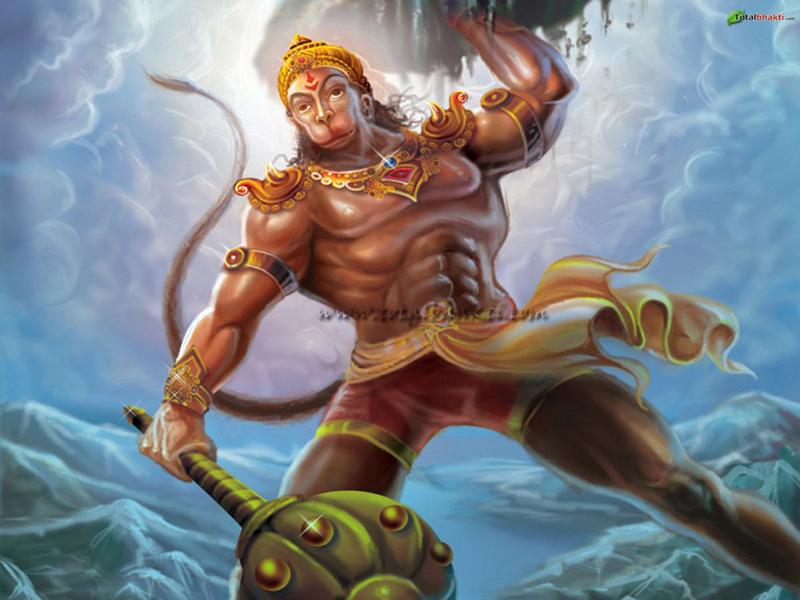
Lord Hanuman or Hanumanji (हनुमान जी) is known by many names as Anjaneya, Anjani Putra, Bajarangabali, Hanuman, Mahaveer, Maruti, Pavanputra etc. Hanuman, the monkey god, is the son of Vayu or Marut, the wind god. Hanuman's mother is Anjani. Hanuman was the chief of the armies of Sri Ramachandra and took a prominent part in the war against Ravana, the king of Lanka, in the Indian epic poem Ramayana. Hanuman helped restore Sri Sitadevi back to Sri Rama.
Hanuman, worshipped for his strength, valor, agility, is a man of great learning. He is considered to be an avatar (incarnation) of Lord Shiva. Hanuman, a great devotee of Sri Rama, is the symbol of devotion and dedication. Hanuman carried Sri Rama and Lakshmana on his shoulder when they were in search of Sugreeva, the king of Vanarav in Kishkindha and helped them to find Sita. Prior to the war between Sri Rama and Ravana, Anjaneya visited Lanka, met Ravana, created havoc and burnt down the city of Lanka (Lanka Dahan). During the war, when Lakshmana was injured seriously, Sushena, the surgeon/physician of the monkey army, despatched Maruti to bring herbal medicine, Jadi Buti, from the far-off Sanjeevini mountain in the Himalayas, before sunrise. Flying over the Himalayas and unable to identify the particular herb fast, Hanuman uprooted and carried the entire Sanjivini mountain in time to save the life of Lakshmana. Hanuman was blessed by Sri Rama with immortality (chiranjeevi).
Hanuman was a bachelor and is worshipped in all the temples of India. Every temple of Sri Rama contains an icon of Hanuman. Worship of Sri Rama is complete only with the worship of Hanuman. Sant Tulsidas composed the 40 stanzas of Hanuman Chalisa in praise of Hanuman. Hanuman Jayanti is the birth anniversary of Lord Hanuman. One cannot understand Hindu Dharma unless one knows Hanuman - the embodiment of servitude.
ॐ अईम भ्रीम हनुमते, श्री राम दूताय नम:
Aum aeem bhreem hanumate, shree ram dootaaya namaha.
We pray to the Lord Hanuman, who is the greatest server and messenger of the Lord incarnate, Shree Rama.
JESUS CHRIST - Your Lord

More than two thousand years ago God sent Jesus Christ into this world. He became one of us, but he did nothing wrong. He showed us what God is like - merciful and kind. He healed the sick people, the blind were made to see, the deaf to hear, the lame to walk. Some people followed him, and to them he gave a new way of life - God’s way. But others hated Him because He was so good, and he exposed their evil ways.
He gave his own life as a sacrifice, a payment for our sins. He died on the cross to save us. Three days after he died, Jesus Christ came back from the dead. Now He lives in the power of an endless life to meet your need, to be your Saviour, to forgive your sins. Jesus Christ is the only one who can do this for you.
If you would like to make Jesus Christ your Lord, your Saviour, then pray and put your trust in Him.
"Thank you, God, for loving me and sending your Son to die on the cross for my sins. I now choose to make Jesus the Lord of my life. Help me to be the kind of person that You want me to be. In Jesus' name, Amen."
In the Bible, God tells us that he created us to have unending fellowship with him, peace with our fellow man, harmony and joy within our family relationships, and to have dominion over the world in which he placed us. But we chose to go another way.
We learn in the same Bible that we, through our forefathers, chose to live our lives for ourselves, rather than to have fellowship with God. This choice of selfishness lead to our earthly death, to no peace with our fellow man, to disharmony and sadness within our family relationships, and to a lack of proper care of the world in which he placed us. Because of this, our future changed to one of eternal separation from fellowship with God after death, completely without hope of joy or peace.
The Bible goes on to record how God provided the remedy for our chosen path of selfishness. He came to us in the form of his son Jesus Christ. This son lived a life of fellowship, peace, harmony, and joy in full fellowship with God. Though innocent of any wrongdoing, he voluntarily allowed himself to suffer and die as a guilty lawbreaker, and received upon himself the full penalty of our selfishness by death on a cross.
The wonderful conclusion recorded in the Bible is that this Jesus rose from the dead and returned to God. He is forever our representative before God. He enables us today to enjoy fellowship with God, peace with our fellow man, harmony and joy within our family relationships, and to exercise proper dominion over this world in which he has placed us. We need only to pray and ask him to come in and rule in our hearts and lives.
Simply talk to God and say, "Thank you, God, for loving me and sending your Son to die on the cross for my sins. I now choose to make Jesus the Lord of my life. Help me to be the kind of person that You want me to be. In Jesus' name, Amen."
You've made the most important decision you will ever make in your life. Jesus said, "If anyone comes toward me, I will not turn him away." He will be your answer to your questions on life's journey.
MAA DURGA DEVI - THE POWER

Durga's story appears primarily in the Skanda Purana, in Chandi, itself a part of the Markandeya Purana, but very similar stories are told in the Brahmanda Purana and also in the famous epic, the Mahabharata. She also appears elsewhere in tantrik texts, including as Mahishamardini (killer of the demon Mahisha) in the Kalachudamani Yantra. The gods lost their empire to two great antigods (asuras), Shumbha and Nishumbha, and prayed to the Goddess for help.
Needless to say, the ever compassionate Devi took on these proud antigods and vanquished them utterly. To this end, she assembled an entire army of Shaktis similar to her and when things became very tough, projected Kalika out of her third eye. She is called Durga because she slayed the son of the arch-demon Durga, son of Ruru.
As the Matrikabheda Tantra points out, the names of the goddess are really adjectives, and she is one, under these different descriptions. For example, the goddess in Chandi takes the forms of Kali, Sarasvati and Vaishnavi, representing the three gunas, to subdue the host of demons.
As Lalita, she subdued the demonic Bhandasura at the request of the gods, who then built the Shri Yantra to celebrate her greatness.
The metaphor is that she is cruel to the demonic; that is to say to the proud ego of man.
LORD VIGNESHWARA

Mushikavaahana modaka hastha,
Chaamara karna vilambitha sutra,
Vaamana rupa maheshwara putra,
Vighna vinaayaka paada namasthe
Birth of Lord Ganesha - The first incident is the birth of Lord Ganesh and how he got his elephant head. When Parvati was idly playing around with some mud one day, she noticed that she had unwittingly created the form of a boy. When she noticed this and expressed surprise at the beauty of the form, she breathed life into it and thus Lord Ganesha was created. This occured in the days when Shiva used to go away on long periods of meditation/tapas. The boy thus grew with time. It then so happened that one day Parvati asked Lord Ganesh to stay outside and guard the house while she bathed. She was specific that nobody should be let inside. The little boy understood the instructions and took it seriously. Thus when Shiva happened to come by and saw a young boy guarding the door, he was surprised. He tried to go in but Lord Ganesha bared him from entering. Shiva questioned him, but the boy simply sayed that his mom has forbid anybody from entering the house. Shiva at first reasoned with him, and then got angry and cut of Lord Ganesh's head with his Trishul (trident). Parvati obviously on hearing this commotion and learning what has happened is disconsolate. She demanded that Shiva restore Ganesha's life at once. But unfortunately, Shiva's Trishul was so powerful that it had hurled Ganesha's head very far off. All attempts to find the head were in vain. As a last resort, Shiva approached Brahma who suggested that he replace Lord Ganesha's head with the first animal that comes his way. Shiva sent his ganas to accordingly get the head of the first thing that they saw. The ganas spotted a baby elephant whose head got transplanted onto Lord Ganesh. That is the reason Mud Ganeshas are made to this day in the villages of India for worship during Lord Ganesh Chaturti and then dissolved in flowing water or well water. ( No other God is worshipped thus ). That is also the reason shape is also given to Lord Ganesha using the auspicious turmeric instead of mud, for "first pooja" before the start of any major pooja.
Lord Ganesha's reverence for his parents - Once there was a competition between Ganesha and his brother Karttikeya as to who could circumambulate the three worlds faster. Karttikeya went off on a journey to cover the three worlds while Ganesha simply circumambulated his parents. When asked why he did so, he answered that, to him his parents meant the three worlds.
Lord Ganesha and Vyasa - When Veda Vyasa was beginning to write the epic Mahabharata, he requested Ganesha to be the scribe. Being playful, Ganesha agreed to be the scribe on one condition - that Vyasa must recite the epic non-stop. Vyasa agreed and thus the great epic of Mahabharata was written by Ganesha.
Lord Ganesh and the moon - Once, Ganesha accidentally tripped and fell, breaking one of his tusks in the process (this is also said to be one of the reasons for Ganesha's half or missing tusk). Chandradev (Moon God) saw this and laughed. Ganesha, being the short-tempered one, cursed Chandradev that anyone who happens to see the moon will incur bad luck. Hearing this, Chandradev realised his folly and asked for forgiveness from Ganesha. Ganesha relented and since a curse cannot be revoked, only softened, Ganesha softened his curse such that anyone who looks at the moon during a Surya-grahan (solar eclipse) would incur bad-luck. Thus was born the notion of not looking at the moon during a solar eclipse in India.
In South India, there is an important festival honoring Lord Ganesha. While it is most popular in the state of Maharashtra, it is performed all over India. It is celebrated for ten days starting from Ganesh Chaturthi. This was introduced by Balgangadhar Tilak as a means of promoting nationalist sentiment when India was ruled by the British. This festival is celebrated and it culminates on the day of Ananta Chaturdashi when the murti of Lord Ganesha is immersed into the most convenient body of water. In Bombay the murti is immersed in the Arabian Sea and in Pune the Mula-Mutha river. In various North and East Indian cities, like Kolkata, they are immersed in the holy Ganga river.
Representations of Shri Ganesh are based on thousands of years of religious symbolism that resulted in the figure of an elephant-head god. In India, the statues are impressions of symbolic significance and thus have never been claimed to be exact replications of a living figure. Lord Ganesh is seen not as a physical entity but a higher spiritual being, and murtis, or statue-representations, act as signifiers of him as an ideal. Thus, to refer to the murtis as idols betrays Western Judeo-Christian understandings of insubstantial object worship, whereas in India, Hindu deities are seen to be accessed through points of symbolic focus known as murtis. For this reason, the immersion of the murtis of Lord Ganesha in nearby holy rivers is undertaken since the murtis are acknowledged to be only temporal understandings of a higher being as opposed to being 'idols,' which have traditionally been seen as objects worshipped for their own sake as divine.
The worship of Ganesha in Japan has been traced back to 806.
Recently, there has been a resurgence of Lord Ganesha worship and an increased interest in the "western world" due to a spate of miracles in september 1995. On september 21, 1995, according to Hinduism Today magazine (www.hinduismtoday.com), as well as the book Ganesha, Remover of Obstacles by Manuela Dunn Mascetti, Ganesh statues in India began spontaneously drinking milk when a spoonful was placed near the mouth of statues honoring the elephant god. The phenomena spread from New Delhi to New York, Canada, Mauritius, Kenya, Australia, Bangladesh, Malaysia, the United Kingdom, Denmark, Sri Lanka, Nepal, Hong Kong, Trinidad, Grenada and Italy among other reported places. This was seen as a miracle by Hindu and non-Hindu alike, and a reminder of the God's playfulness and love of pranks and tricks.
Like other Hindu gods and goddesses, Ganesh has many other titles of respect or symbolic names, and is often worshipped through the chanting of sahasranam (pronounced saa-HUS-ruh-naam), or a thousand names. Each is different and conveys a different meaning, representing a different aspect of the god in question. Needless to say, almost all Hindu gods have one or two accepted versions of their own sahasranaam liturgy.
Lord Ganesha is also known by other names:
Aumkara, the Aum-shaped body
Ganapati, Lord of the Ganas, a race of dwarf beings in the army of Shiva
Vakratunda, Curved Trunk
Ekadanta, One-Tusked
Shupakarna, Large/Auspicious Ears
Gajanana, elephant face
Anangapujita, The Formless, or Bodiless
Lambodara, big bellied
Vinayaka (knowledgeable)
Vignesh, Vigneshwara (Vighna = obstacle, eeshwar=lord)
Vignaharta, remover of obstacles
Pillaiyar ("whose child?", Shiva's question in one story of how Ganesh got his head)
Chaamara karna vilambitha sutra,
Vaamana rupa maheshwara putra,
Vighna vinaayaka paada namasthe
Birth of Lord Ganesha - The first incident is the birth of Lord Ganesh and how he got his elephant head. When Parvati was idly playing around with some mud one day, she noticed that she had unwittingly created the form of a boy. When she noticed this and expressed surprise at the beauty of the form, she breathed life into it and thus Lord Ganesha was created. This occured in the days when Shiva used to go away on long periods of meditation/tapas. The boy thus grew with time. It then so happened that one day Parvati asked Lord Ganesh to stay outside and guard the house while she bathed. She was specific that nobody should be let inside. The little boy understood the instructions and took it seriously. Thus when Shiva happened to come by and saw a young boy guarding the door, he was surprised. He tried to go in but Lord Ganesha bared him from entering. Shiva questioned him, but the boy simply sayed that his mom has forbid anybody from entering the house. Shiva at first reasoned with him, and then got angry and cut of Lord Ganesh's head with his Trishul (trident). Parvati obviously on hearing this commotion and learning what has happened is disconsolate. She demanded that Shiva restore Ganesha's life at once. But unfortunately, Shiva's Trishul was so powerful that it had hurled Ganesha's head very far off. All attempts to find the head were in vain. As a last resort, Shiva approached Brahma who suggested that he replace Lord Ganesha's head with the first animal that comes his way. Shiva sent his ganas to accordingly get the head of the first thing that they saw. The ganas spotted a baby elephant whose head got transplanted onto Lord Ganesh. That is the reason Mud Ganeshas are made to this day in the villages of India for worship during Lord Ganesh Chaturti and then dissolved in flowing water or well water. ( No other God is worshipped thus ). That is also the reason shape is also given to Lord Ganesha using the auspicious turmeric instead of mud, for "first pooja" before the start of any major pooja.
Lord Ganesha's reverence for his parents - Once there was a competition between Ganesha and his brother Karttikeya as to who could circumambulate the three worlds faster. Karttikeya went off on a journey to cover the three worlds while Ganesha simply circumambulated his parents. When asked why he did so, he answered that, to him his parents meant the three worlds.
Lord Ganesha and Vyasa - When Veda Vyasa was beginning to write the epic Mahabharata, he requested Ganesha to be the scribe. Being playful, Ganesha agreed to be the scribe on one condition - that Vyasa must recite the epic non-stop. Vyasa agreed and thus the great epic of Mahabharata was written by Ganesha.
Lord Ganesh and the moon - Once, Ganesha accidentally tripped and fell, breaking one of his tusks in the process (this is also said to be one of the reasons for Ganesha's half or missing tusk). Chandradev (Moon God) saw this and laughed. Ganesha, being the short-tempered one, cursed Chandradev that anyone who happens to see the moon will incur bad luck. Hearing this, Chandradev realised his folly and asked for forgiveness from Ganesha. Ganesha relented and since a curse cannot be revoked, only softened, Ganesha softened his curse such that anyone who looks at the moon during a Surya-grahan (solar eclipse) would incur bad-luck. Thus was born the notion of not looking at the moon during a solar eclipse in India.
In South India, there is an important festival honoring Lord Ganesha. While it is most popular in the state of Maharashtra, it is performed all over India. It is celebrated for ten days starting from Ganesh Chaturthi. This was introduced by Balgangadhar Tilak as a means of promoting nationalist sentiment when India was ruled by the British. This festival is celebrated and it culminates on the day of Ananta Chaturdashi when the murti of Lord Ganesha is immersed into the most convenient body of water. In Bombay the murti is immersed in the Arabian Sea and in Pune the Mula-Mutha river. In various North and East Indian cities, like Kolkata, they are immersed in the holy Ganga river.
Representations of Shri Ganesh are based on thousands of years of religious symbolism that resulted in the figure of an elephant-head god. In India, the statues are impressions of symbolic significance and thus have never been claimed to be exact replications of a living figure. Lord Ganesh is seen not as a physical entity but a higher spiritual being, and murtis, or statue-representations, act as signifiers of him as an ideal. Thus, to refer to the murtis as idols betrays Western Judeo-Christian understandings of insubstantial object worship, whereas in India, Hindu deities are seen to be accessed through points of symbolic focus known as murtis. For this reason, the immersion of the murtis of Lord Ganesha in nearby holy rivers is undertaken since the murtis are acknowledged to be only temporal understandings of a higher being as opposed to being 'idols,' which have traditionally been seen as objects worshipped for their own sake as divine.
The worship of Ganesha in Japan has been traced back to 806.
Recently, there has been a resurgence of Lord Ganesha worship and an increased interest in the "western world" due to a spate of miracles in september 1995. On september 21, 1995, according to Hinduism Today magazine (www.hinduismtoday.com), as well as the book Ganesha, Remover of Obstacles by Manuela Dunn Mascetti, Ganesh statues in India began spontaneously drinking milk when a spoonful was placed near the mouth of statues honoring the elephant god. The phenomena spread from New Delhi to New York, Canada, Mauritius, Kenya, Australia, Bangladesh, Malaysia, the United Kingdom, Denmark, Sri Lanka, Nepal, Hong Kong, Trinidad, Grenada and Italy among other reported places. This was seen as a miracle by Hindu and non-Hindu alike, and a reminder of the God's playfulness and love of pranks and tricks.
Like other Hindu gods and goddesses, Ganesh has many other titles of respect or symbolic names, and is often worshipped through the chanting of sahasranam (pronounced saa-HUS-ruh-naam), or a thousand names. Each is different and conveys a different meaning, representing a different aspect of the god in question. Needless to say, almost all Hindu gods have one or two accepted versions of their own sahasranaam liturgy.
Lord Ganesha is also known by other names:
Aumkara, the Aum-shaped body
Ganapati, Lord of the Ganas, a race of dwarf beings in the army of Shiva
Vakratunda, Curved Trunk
Ekadanta, One-Tusked
Shupakarna, Large/Auspicious Ears
Gajanana, elephant face
Anangapujita, The Formless, or Bodiless
Lambodara, big bellied
Vinayaka (knowledgeable)
Vignesh, Vigneshwara (Vighna = obstacle, eeshwar=lord)
Vignaharta, remover of obstacles
Pillaiyar ("whose child?", Shiva's question in one story of how Ganesh got his head)
LORD VENKATESHWARA - TIRUMALA

Now as we know the Avatars of Lord Vishnu, let’s know the Story of Lord Venkateshwara Swamy, who is called as KALIYUGA DAIVAM (the LORD OF KALIYUGA)
The Story:
On the request of Sowanka and other sages, Sootha maharshi narrated them the story of Sri Venkateswara. Sage Narada who will always be moving from one place to another entered Sathya Loka and saluted his parents Barahama and Saraswathi told Brahma that after Krishna Avatar, Sri Hari did not go to Bhooloka again and therefore, it has become a hell, as innocent are teased by the wicked. They therefore decided that time has come when God has to appear again on earth and restore Dharma. Narada descended to Bhooloka and decided that Brighu Maharshi would conduct test as who among Trimurtis will bear the Yagna effect. Accordingly Brighu Maharshi first went to Satyaloka where Brahma was explaining the Vedas to several eminent rishis seated there.
When, Brighu Maharshi occupied the throne without showing any respect and without saluting, Brahma lost his temper and chided Brighu. Brighu got down from the throne and cursed Brahma saying "YOU WILL NOT HAVE ANY TEMPLE IN THE EARTH AND NONE WILL WORSHIP YOU".
Brighu, then went to Kailash where Shiva was in privacy with his wife Parvathi. Enraged Siva took his Trisool to finish Brighu but stopped on the intervention of Parvathi. Brighu in his turn also cursed Siva saying, "YOU WILL BE WORSHIPPED IN THE TEMPLE ON EARTH IN THE SHAPE OF "LINGA" INSTEAD OF YOUR REAL SHAPE", and left to Vaikuntham to request Maha Vishnu to bear the Yagna effects.
Maha Vishnu though aware of the arrival of Brighu pretended to be innocent resting on the Sesha Sayanam and Maha Laxmi sitting near his feet pressing them. Recalling the maltreatment meted out to him at Sathyaloka and Kailash, Brighu rushed towards Maha Vishnu and kicked him on his chest with right foot. Without showing any annoyance, Vishnu pinched the third eye that was embedded in Brighu's right foot with the result, he lost his power and pride. Repented Brighu then explained the purpose of his visit. Sri MahaVishnu promised to receive the benefit of Yagna being conducted by the eminent sages on the banks of Ganga at the appropriate time. Lakshmi who was witnessing all these acts however got angry with her husband especially because, he tended such a rude person who dishonored her by kicking in the chest of Maha Vishnu where she lived. When Lakshmi left Vaikuntham there was no pleasure and pomp. Maha Vishnu became helpless. He ran helter and skelter in search of Lakshmi without food and sleep and atlast reached Tirupati and took shelter in a Valmikam (anthill) at the Adi Varsha's shrine meditating for the return of Lakshmi.
Narada came to know the separation and the dwelling places of Lakshmi, at Kolhapur and of Maha Vishnu at Venkatachalam. Narada as directed by Brahma met her and narrated how Sri Hari is starving for food and much reduced. Worried Lakshmi prayed Brahma and Shiva and the three decided to take the shape of a cow, a calf and a cow-herd woman. As a cow-herd woman Lakshmi sold the cow and the calf to Chola King. In the guise of cow Brahma daily gave rain of milk to Sri Hari and returned home with no drop of milk.
The Chola Queen who desired to feed her child with the milk from the new cow suspected that the cow-herd boy of stealing the milk and ordered him to bring the milk of the new cow at any cost next day. With a fear of severe punishment the cow-herd boy followed the cow and saw at Valmiki it is raining milk through her breast. The cow-herd boy burst into anger and took his axe and tried to hurt the animal. Sri Hari immediately came out of the Valmiki (anthill) and saved the cow and bore that blow on his head and started bleeding profusely. The Chola King seeing the sprinkles of blood on the cow reached Valmiki and after hearing sighing sound from there found Maha Vishnu in a pool of blood. On seeing the Chola King Maha Vishnu got wild and cursed him to become a ghost as he got the wound through his cow-herd. Chola King begged for pardon. Maha Vishnu relented and gave him a boon to reborn in the same family as Akasa Raju. He pitied cow-heard boy and gave him a boon that his generation to have the first Darshan of the Lord in his temple.
Jaya and Vijaya who were the guards at the entrance of Vaikuntham became Harinyaksha and Hiranyakasipu with the curse of Sanakasada nanda and other Sages. Hiranyaksha was very cruel and troubling innocent people. Mahavishnu therefore took the form of white pig (Varaham) and diving into the sea killed Hiranyaksha and brought the earth up which he rolled it as a mat and hid in the Pathala loka.
The foster Mother of Lord Krishna, Yasoda Devi though tended him as a child never witnessed his marriages. Lord Krishna consoled her and promised to create an opportunity in Kaliyuga. Yasoda, therefore was born as Vakuladevi and became a devotee of Varaha Swamy. Sri Hari with a wounded head was wandering in the woods in search of a suitable medicine. On the advice of Brihaspati, the Guru of Devas who met him in the forest, went in search of a fig tree to apply its milk mixing it with the other herbs to the wound and chanced upon to hear Sri Krishna Bhajana and walked towards the cottage crying in pain "mother" "mother". Vakuladevi heard the call, and after fondly enquiring applied the medicine, fed him with some fruits and milk, and named him as Srinivasa. Sri Hari revealed to her his previous birth as Lord Krishna. Overjoyed, she bathed him and took to Varaha Swamy. On his request Varahaswamy gave him 100 sqft of land with a promise that all the pilgrims to Tirupati first visit his Temple, then have Darshan of Sri Venketeswara. The image of Sri Venkateswara is self manifest (Swayambhu) and not prepared by any mortal.
The celebrated temple of Sri Venkateswara stands on a hill named Venkatadri. It is very difficult to determine the date of this temple. Inscriptions found in the temple only refer to its renovation, rebuilding and addition made to the main temple. The earliest inscription found at Tirumala records the birth of Bana Prince named Vijayaditya who ruled during the half of the 9th Century A.D. The first mention of the temple on the hill is to be found in an inscription assignable to 970 A.D. A renovation made in the 13th Century was done as to preclude a view of the original Sanctum. From then onwards the rulers who ruled the place and devoted to the Lord made several gifts and offerings and structural changes whenever necessary.
The Story:
On the request of Sowanka and other sages, Sootha maharshi narrated them the story of Sri Venkateswara. Sage Narada who will always be moving from one place to another entered Sathya Loka and saluted his parents Barahama and Saraswathi told Brahma that after Krishna Avatar, Sri Hari did not go to Bhooloka again and therefore, it has become a hell, as innocent are teased by the wicked. They therefore decided that time has come when God has to appear again on earth and restore Dharma. Narada descended to Bhooloka and decided that Brighu Maharshi would conduct test as who among Trimurtis will bear the Yagna effect. Accordingly Brighu Maharshi first went to Satyaloka where Brahma was explaining the Vedas to several eminent rishis seated there.
When, Brighu Maharshi occupied the throne without showing any respect and without saluting, Brahma lost his temper and chided Brighu. Brighu got down from the throne and cursed Brahma saying "YOU WILL NOT HAVE ANY TEMPLE IN THE EARTH AND NONE WILL WORSHIP YOU".
Brighu, then went to Kailash where Shiva was in privacy with his wife Parvathi. Enraged Siva took his Trisool to finish Brighu but stopped on the intervention of Parvathi. Brighu in his turn also cursed Siva saying, "YOU WILL BE WORSHIPPED IN THE TEMPLE ON EARTH IN THE SHAPE OF "LINGA" INSTEAD OF YOUR REAL SHAPE", and left to Vaikuntham to request Maha Vishnu to bear the Yagna effects.
Maha Vishnu though aware of the arrival of Brighu pretended to be innocent resting on the Sesha Sayanam and Maha Laxmi sitting near his feet pressing them. Recalling the maltreatment meted out to him at Sathyaloka and Kailash, Brighu rushed towards Maha Vishnu and kicked him on his chest with right foot. Without showing any annoyance, Vishnu pinched the third eye that was embedded in Brighu's right foot with the result, he lost his power and pride. Repented Brighu then explained the purpose of his visit. Sri MahaVishnu promised to receive the benefit of Yagna being conducted by the eminent sages on the banks of Ganga at the appropriate time. Lakshmi who was witnessing all these acts however got angry with her husband especially because, he tended such a rude person who dishonored her by kicking in the chest of Maha Vishnu where she lived. When Lakshmi left Vaikuntham there was no pleasure and pomp. Maha Vishnu became helpless. He ran helter and skelter in search of Lakshmi without food and sleep and atlast reached Tirupati and took shelter in a Valmikam (anthill) at the Adi Varsha's shrine meditating for the return of Lakshmi.
Narada came to know the separation and the dwelling places of Lakshmi, at Kolhapur and of Maha Vishnu at Venkatachalam. Narada as directed by Brahma met her and narrated how Sri Hari is starving for food and much reduced. Worried Lakshmi prayed Brahma and Shiva and the three decided to take the shape of a cow, a calf and a cow-herd woman. As a cow-herd woman Lakshmi sold the cow and the calf to Chola King. In the guise of cow Brahma daily gave rain of milk to Sri Hari and returned home with no drop of milk.
The Chola Queen who desired to feed her child with the milk from the new cow suspected that the cow-herd boy of stealing the milk and ordered him to bring the milk of the new cow at any cost next day. With a fear of severe punishment the cow-herd boy followed the cow and saw at Valmiki it is raining milk through her breast. The cow-herd boy burst into anger and took his axe and tried to hurt the animal. Sri Hari immediately came out of the Valmiki (anthill) and saved the cow and bore that blow on his head and started bleeding profusely. The Chola King seeing the sprinkles of blood on the cow reached Valmiki and after hearing sighing sound from there found Maha Vishnu in a pool of blood. On seeing the Chola King Maha Vishnu got wild and cursed him to become a ghost as he got the wound through his cow-herd. Chola King begged for pardon. Maha Vishnu relented and gave him a boon to reborn in the same family as Akasa Raju. He pitied cow-heard boy and gave him a boon that his generation to have the first Darshan of the Lord in his temple.
Jaya and Vijaya who were the guards at the entrance of Vaikuntham became Harinyaksha and Hiranyakasipu with the curse of Sanakasada nanda and other Sages. Hiranyaksha was very cruel and troubling innocent people. Mahavishnu therefore took the form of white pig (Varaham) and diving into the sea killed Hiranyaksha and brought the earth up which he rolled it as a mat and hid in the Pathala loka.
The foster Mother of Lord Krishna, Yasoda Devi though tended him as a child never witnessed his marriages. Lord Krishna consoled her and promised to create an opportunity in Kaliyuga. Yasoda, therefore was born as Vakuladevi and became a devotee of Varaha Swamy. Sri Hari with a wounded head was wandering in the woods in search of a suitable medicine. On the advice of Brihaspati, the Guru of Devas who met him in the forest, went in search of a fig tree to apply its milk mixing it with the other herbs to the wound and chanced upon to hear Sri Krishna Bhajana and walked towards the cottage crying in pain "mother" "mother". Vakuladevi heard the call, and after fondly enquiring applied the medicine, fed him with some fruits and milk, and named him as Srinivasa. Sri Hari revealed to her his previous birth as Lord Krishna. Overjoyed, she bathed him and took to Varaha Swamy. On his request Varahaswamy gave him 100 sqft of land with a promise that all the pilgrims to Tirupati first visit his Temple, then have Darshan of Sri Venketeswara. The image of Sri Venkateswara is self manifest (Swayambhu) and not prepared by any mortal.
The celebrated temple of Sri Venkateswara stands on a hill named Venkatadri. It is very difficult to determine the date of this temple. Inscriptions found in the temple only refer to its renovation, rebuilding and addition made to the main temple. The earliest inscription found at Tirumala records the birth of Bana Prince named Vijayaditya who ruled during the half of the 9th Century A.D. The first mention of the temple on the hill is to be found in an inscription assignable to 970 A.D. A renovation made in the 13th Century was done as to preclude a view of the original Sanctum. From then onwards the rulers who ruled the place and devoted to the Lord made several gifts and offerings and structural changes whenever necessary.
SHIRIDI SAI BABA

Shri Saibaba of Shirdi lived between 1838 and 1918, whose real name, birthplace and date of birth are not known. An Indian spiritual guru and a fakir that transcended the barriers of religions, Saibaba of Shirdi was regarded with great reverence by both Hindu and Muslim followers. He lived in a mosque and after death his body was cremated in a temple.
His philosophy ingrained 'Shraddha' meaning faith and 'Saburi' meaning compassion. According to him Shraddha and Saburi were the supreme attributes to reach the state of godliness.
It is believed that at a tender age of 16 yrs Shri Saibaba arrived at the village of Shirdi in Ahmednagar district of Maharashtra and remained their till his death. He found shelter in Khandoba temple, where a villager Mahalsapathi in the temple addressed him as Sai or Saint.
Saibaba of Shirdi lived an extremely simple and austere life, sleeping on the floor of temple and later taking a ruined mosque as his shelter. With his arrival to Shirdi, in no time he began exhibiting a hypnotic attraction among people as they began flocking to him. He is attributed many miracles doing things that were beyond a mortal's power. He never discouraged these attributes and soon his fame spread like wild fire. Many pilgrims came seeking his blessings. Such was his hypnotism that even the mundane of his activities attracted large crowds.
Popular among both Hindus and Muslims, Shri Saibaba became a great building force between the two disparate communities. He regularly recited Hindu and Muslim prayers. His Hindu followers considered him to be an avatar or reincarnation of Shiva and Dattatreya. Sai Baba did not leave any written works. All his teachings were oral and catchy. His sayings were short, crisp and in layman language with which the common mass could easily associate.
Saibaba encouraged charity and said, "Unless there is some relationship or connection, nobody goes anywhere. If any men or creatures come to you, do not discourteously drive them away, but receive them well and treat them with due respect."
Shri Sai Baba of Shirdi was unique in the sense that he lived his message through the essence of his being. He lived among the common people adorning a torn kafni (long robe), sleeping over a mat while using brick as his headrest and got his food by begging. Such was his smile that radiated a mystical charisma and deep seated inward look that hypnotized the people who visited him.
His most concise message for one and all alike was "Why fear when I am here".
Saibaba said that he was a slave in the service of those who loved him. He was ever living to help those who turn to him and that he has to take care of his children day and night.
Saibaba's mission was to restore belief in god and according to him, "I give people what they want in the hope that they will begin to want what I want to give them (knowledge of the Ultimate)." He then taught values of total surrender to the Almighty Master (ALLAH MALIK EK- The only ONE) and experiences his grace.
Today, Shri Saibaba has millions of devotees in India and abroad. Shirdi, the obscure village in Maharashtra has become a pilgrimage destination much as Bethlehem, Jerusalem or Varanasi. With over 25,000 pilgrims thronging in here each day the number of pilgrims climb to over a hundred thousand on holidays and festival days. There are over 2,000 major Sai temples in different parts of India and 150 abroad in places as far-flung as Canada and Kenya, Singapore and England.
LORD GANESH

Lord Vinayaka, The Great God of Hinduism is humbly adorned by the Hindu people from all over the world in their daily life. He is the Elder Son of Lord Shiva and has significance in almost all temples of Hinduism in all over the world. Lord Ganesh, Lord Vignesh, Lord Ganapathy, Lord Pillayar are some of the other names of this God. Lord Vinayaka means one who has no leader and He is the leader of all and Lord Vignesh means that He is the God of averting obstacles. Here Vigna means obstacles. Lord Ganesh or Lord Ganapathy means that He is the Captain of all good forces. The mouse is the vehicle of Lord Vinayaka. In every temple of India there is an idol of mouse placed infront of Him. The people suffering from malefic planets are faithfully worshipping Him to get relief of them. Lord Vinayaka Moola Mantra is 'Om Gam Ganapataye Namaha'
Lord Vinayaka Has the peculiar shape with elephant face and big belly which attracts all the people and even the people belonging to the religions other than Hinduism. The trunk of His elephant face is resembling the Tamil script of OM and it is believed that meditating His elephant face will produce special results in our daily activities.
The Hindu people are used to write His associated script before writing any letter or article on the top of the paper as they are celebrating Him as the God of averting obstacles. Whenever the students are getting prepared to go to attend the exams, they give first preference to Lord Vinayaka to pray Him so as to get high marks. The newly started companies, shops are celebrating this Great God to get success and acheive the goal in their endavours.
Lord Vinayaka has temples everywhere in all parts of India. The temple of Him usually situated under a pupil tree or on the bank of a river. Hence He is the God of poor people His temples are found in the all parts of the country.
The story of Lord Vinayaka
The following story is narrated about the birth and how He came to have an elephant head. Once upon a time Godess Shakthi wanted to take bath in Her home after creating Lord Ganesh out of white mud by Her spiritual power. She put Him as a security and told Him not to allow any body inside. Lord Shiva was returning home and stopped by Lord Vinayaka. Lord Shiva got angry and cut off his head as He thought Lord Vinayaka was an outsider. When Godess Shakthi came to know this she was sorely grieved. To console Her Lord Shiva ordered His servants to bring a head of any creature that might be sleeping its head facing north. The servants went on their mission and found only an elephant in that position. The sacrifice was thus made and the elephant's head was brought before Lord Shiva. The Lord then joined the elephant's head to the body of Lord Vinayaka. Lord Shiva made His son worthy of worsip at the begining of all undertakings, marriages, studies, etc. He ordained the annual worship of Lord Vinayaka.
Vinayaka Chaturti
This is the grand festival of Hindu people in which the total prominence is given to Lord Vinayaka. It comes on every 4 th new moon day of August or September of every year. In the evening of the day people are decorating the idol or the picture of Lord Vinayaka with flowers and garlands and humbly present Him three varieties of fruits, pot roasted rice flakes, grams, boiled grams and steam boiled flour recipe with the ingredients of coconut pieces, sugar and cardamom in little amount. On the same day, small idols of Vinayaka made of mud are available in all parts of the country. The next day people carry the idols of Lord Vinayaka and immerse them in the pond or river.
On this same day of the festival in all the cities and towns of India many groups of people are arranging gaint idol of the Lord Vinayaka and placed it on the important corners of the cities and towns. The public people are allowed to worship Lord Vinayaka. On the second or third day of the festival all the gaint idols are collected and placed in the lorries for leading procession along the important streets of the cities and towns. The procession finally reaches the pond or sea to immerse the idols of the Lord Vinayaka.
Different Images of Lord Vinayaka
Lord Vinayaka Has different images to offer blessings to His faithful devotees. The Most popular among them is Shri Karpaga Vinayaka. His main temple is situated at Pillayar patti in Tamil nadu. He is associated with plenty of wealth and health which He offers to his faithful devotees.
Lord Siddhi Vinayaka is the other image. His consort's name is Siddhi and so called in that name. He is believed as the provider of wishes and His main temple in the country is at Prabhavathi area of Mumbai. This famous temple was built in the year 1801 by Mr. Laxman and Mrs Deubai patil. The magnificient view of this temple makes it as one of the main tourist attractions of Mumbai. It is crowded in all the days of the year.
Lord Uchi pillayar is another image of the Lord and His temple is situated at Trichy of Tamilnadu. The Lord Vinayaka here is sitting at the top of a huge rock in 95 metre high in the middle of the town. On the top of the rock we can get dharsan of Lord Uchi Pillayar and also enjoy the magnificient view of the city.
Lord Bala Vinayaka is the youth or child form of Vinayaka in which He has been accompanied with His brother Lord Muruga and worshipping their Father Lord Shiva. This form of the Lord shows the great truth of God of God.
Lord Selva Vinayaka is the decorated form of Lord Vinayaka with gold jewels and ornaments. He is associated with wealth to offer the wealthy life to His devotees.
Lord Mukkuruni Vinayaka is the gaint form of Vinayaka and situated in the temple complex of Madurai Meenakshi Temple. His big belly reveals the truth of each and every thing of the universe is included into it.
Lord Veera Vinayaka is the standing form of the Lord Who is reday to destroy the evil things to save the innocent people from them. He Has many heads and hands in this form. He is also equipped with many weapons in this form.
LORD BRAHMA - THE CREATOR

Lord Brahma is part of the Hindu trinity, which includes Lord Vishnu and Lord Shiva. Brahma, the infinite, the source of all space, time, causation, names and forms, has many interesting and instructive designations. Theologically, he is the single letter (eka aksharam) AUM, and the uncreated creator (svayambhu), the self-born first person. Philosophically, he is the first manifestation of one's existence (ahankara). Cosmologically, he is hiranya garbha (golden embryo), the ball of fire, from which the universe develops. He is Prajapati, since all creatures are his progeny. He is pitamaha (patriarch), vidhi (ordinator), Iokesha (master of the universe), dhatru (sustainer) and Viswakarma (architect of the world). Mythology describes Brahma as springing from Kamala (lotus), from the nabhi (navel) of Vishnu. Hence, his names Nabhija (navel born), Kanja (water born). His consort Saraswati manifested out of him and all creatures of the world resulted from their union.
Brahma and Saraswati
Brahma and his consort Saraswati, represent the vedas, their spirit and meaning. They form the subject of many tales in Hindu literature. All knowledge, religious and secular emanate from them. The name Narayana (one dwelling in the causal water, the abode of man) was applied to him first and later to Vishnu. The Avataras (incarnations) of fish (matsya) and tortoise (koorma) (later called the avataras of Vishnu), the boar (varaha) to raise the earth from under the waters and created the world, the sages, and prajapatis were all attributed to Brahma originally and shifted to Vishnu later. Brahma, created all knowledge, sciences, arts, music, dance and drama. He also officiated over the wedding of Shiva and Parvati.
Origin of Brahma
Accounts of creation differ in many respects. As per Hindu mythology, Brahma was born from a (kamala) lotus springing from Vishnu's navel and created the world through his daughter Saraswati. According to Manu Smriti, the self- existent Lord manifested to dispel the darkness enveloping universe. He created the waters and deposited a seed that became a golden egg from which he was born as Brahma. He divided the egg into two parts to construct the heaven and earth, and created the ten Prajapatis, mind-born sons, who completed the work of creation. By a third account, the Lord separated himself into two parts, the male and the female after dividing the golden egg. From him sprang Viraja and from him Manu. Ramayana states that Brahma sprang from the ether and that sages Marichi, Atri, Angiras, Narada, Sanaka, Sanandana, Sanatkumara, Sanasujata and others are his manasa putras (mentally conceived sons). From Marichi sprang Kashyapa from whom sprang Vishwavata who created Manu, the procreator of all human beings. Thus, Manu is Brahma's great grandson.
Demise of Brahma Concept
Despite the fact that Brahma is one of the trimurthis, there are no temples dedicated to his worship, except the place of pilgrimage, Pushkar in Ajmer. Puranas give crude reasons for this. Some scholars believe that Brahma cult existed in pre- Vedic Hinduism and was superseded by Siva-Vishnu cult later. The Shakti concept, in which both Shiva and Vishnu have their consort and creation proceeds from the combination of the god and his shakti, has made the Brahma concept redundant.
Representations of Brahma
Mythology has it that Brahma originally had five heads. One of them was cut down by Shiva in his rage. Now, Brahma's icon has four heads (chatur mukha brahma) facing the four quartem. They represent the four Vedas (Rig, Yajur, Sama, Atharva), the four yugas (krita, treta, dwapara, kali) (epochs of time), the four varnas (brahmana, kshatriya, vaisya, sudra). The faces have beards with eyes closed in meditation. There are four arms holding up different objects, akshamala (rosary), kurcha (kusha grass), sruk (ladle), sruva (spoon), kamandala (water pot) and pustaka (book) and in different poses representing the four quartem. Their combination and arrangement vary with the image. Akshamala symbolizes time; Kamandala, the waters of all creation. The implements kusha, sruk and sruva, denote the system of sacrifices used by creatures to sustain each other. The book represents religious and secular knowledge. Hand postures (mudras) are abhaya (protector) and varada (giver of boons). The icon may be in standing posture on a lotus or in sitting posture on a hamsa (swan). Hamsa stands for wisdom and discrimination.
Brahma is also shown riding a chariot drawn by seven swans, representing the seven worlds. Temples dedicated to Brahma show his Viswakarma aspect with four heads, the four arms holding the rosary, the book, kusha and kamandala and riding his swan. Temples of Shiva or Vishnu have a niche in the northern wall for Brahma as a parivara devata and his image receives daily worship
Brahma and Saraswati
Brahma and his consort Saraswati, represent the vedas, their spirit and meaning. They form the subject of many tales in Hindu literature. All knowledge, religious and secular emanate from them. The name Narayana (one dwelling in the causal water, the abode of man) was applied to him first and later to Vishnu. The Avataras (incarnations) of fish (matsya) and tortoise (koorma) (later called the avataras of Vishnu), the boar (varaha) to raise the earth from under the waters and created the world, the sages, and prajapatis were all attributed to Brahma originally and shifted to Vishnu later. Brahma, created all knowledge, sciences, arts, music, dance and drama. He also officiated over the wedding of Shiva and Parvati.
Origin of Brahma
Accounts of creation differ in many respects. As per Hindu mythology, Brahma was born from a (kamala) lotus springing from Vishnu's navel and created the world through his daughter Saraswati. According to Manu Smriti, the self- existent Lord manifested to dispel the darkness enveloping universe. He created the waters and deposited a seed that became a golden egg from which he was born as Brahma. He divided the egg into two parts to construct the heaven and earth, and created the ten Prajapatis, mind-born sons, who completed the work of creation. By a third account, the Lord separated himself into two parts, the male and the female after dividing the golden egg. From him sprang Viraja and from him Manu. Ramayana states that Brahma sprang from the ether and that sages Marichi, Atri, Angiras, Narada, Sanaka, Sanandana, Sanatkumara, Sanasujata and others are his manasa putras (mentally conceived sons). From Marichi sprang Kashyapa from whom sprang Vishwavata who created Manu, the procreator of all human beings. Thus, Manu is Brahma's great grandson.
Demise of Brahma Concept
Despite the fact that Brahma is one of the trimurthis, there are no temples dedicated to his worship, except the place of pilgrimage, Pushkar in Ajmer. Puranas give crude reasons for this. Some scholars believe that Brahma cult existed in pre- Vedic Hinduism and was superseded by Siva-Vishnu cult later. The Shakti concept, in which both Shiva and Vishnu have their consort and creation proceeds from the combination of the god and his shakti, has made the Brahma concept redundant.
Representations of Brahma
Mythology has it that Brahma originally had five heads. One of them was cut down by Shiva in his rage. Now, Brahma's icon has four heads (chatur mukha brahma) facing the four quartem. They represent the four Vedas (Rig, Yajur, Sama, Atharva), the four yugas (krita, treta, dwapara, kali) (epochs of time), the four varnas (brahmana, kshatriya, vaisya, sudra). The faces have beards with eyes closed in meditation. There are four arms holding up different objects, akshamala (rosary), kurcha (kusha grass), sruk (ladle), sruva (spoon), kamandala (water pot) and pustaka (book) and in different poses representing the four quartem. Their combination and arrangement vary with the image. Akshamala symbolizes time; Kamandala, the waters of all creation. The implements kusha, sruk and sruva, denote the system of sacrifices used by creatures to sustain each other. The book represents religious and secular knowledge. Hand postures (mudras) are abhaya (protector) and varada (giver of boons). The icon may be in standing posture on a lotus or in sitting posture on a hamsa (swan). Hamsa stands for wisdom and discrimination.
Brahma is also shown riding a chariot drawn by seven swans, representing the seven worlds. Temples dedicated to Brahma show his Viswakarma aspect with four heads, the four arms holding the rosary, the book, kusha and kamandala and riding his swan. Temples of Shiva or Vishnu have a niche in the northern wall for Brahma as a parivara devata and his image receives daily worship
LORD SHIVA
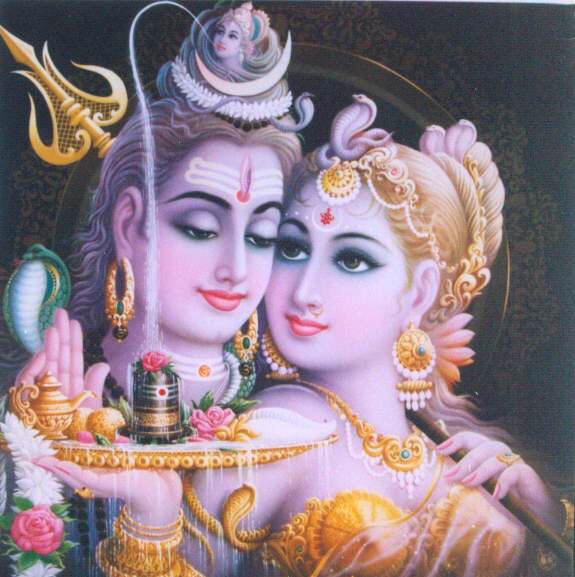
Shiva is 'shakti' or power, Shiva is the destroyer, the most powerful god of the Hindu pantheon and one of the godheads in the Hindu Trinity. Known by many names - Mahadeva, Mahayogi, Pashupati, Nataraja, Bhairava, Vishwanath, Bhava, Bhole Nath - Lord Shiva is perhaps the most complex of Hindu deities. Hindus recognize this by putting his shrine in the temple separate from those of other deities
Lord Shiva appears in a meditating but ever-happy posture. He has matted hair which holds the flowing Ganges river and a crescent moon, a serpent coiled around his neck, a trident (trishul) in his one hand and ashes all over his body.
The Lord's attributes represent his victory over the demonic activity, and calmness of human nature. He is known as the "giver" god. His vehicle is a bull (symbol of happiness and strength) named Nandi.
Shiva-Linga, a sign of the Lord, is adored instead of him. Shiva temples have Shiva-Linga as the main deity.
LORD VISHNU

Lord Vishnu, one of the major gods in Hinduism, is the second member of the Holy Trinity. He is regarded as the preserver of dharma in the universe. Hari, which means the remover, is one among his many names. Lord Vishnu is also hailed by the names Lord Venkateshwara and Narayana.
Vishnu has four hands, each holding a sankha (conch shell), chakra (the discus that destroys evil), gada (mace) and padma (lotus) respectively. Garuda, the mighty eagle that disseminates Vedic knowledge, is his vehicle. Lakshmi, the goddess of wealth and prosperity, is Vishnu's consort. He is always represented as dark in color, lying on Adisesha or Anantha, the huge serpent, which indicates sleeping universe. Lord Vishnu is also hailed by the name Anantha Padmanabha. The avtars (incarnations) Vishnu adopted for the destruction of evil are Matsya (fish), Kurma (turtle), Varaha (boar), Narasimha (the man-lion), Vamana (the dwarf), Parashurama (the warrior-priest), Rama (the prince), Krishna (the cowherd), Buddha-Mayamoha (the sage) and Kalki (the horseman). Instead of Buddha-Mayamoha, sometimes Balarama is also considered an incarnation.
The tradition of Vishnu worship (Vaishnavism) has been prevalent in India since very early times. Jayadeva and Surdas were two major Vaishnavite saints.
Vishnu has four hands, each holding a sankha (conch shell), chakra (the discus that destroys evil), gada (mace) and padma (lotus) respectively. Garuda, the mighty eagle that disseminates Vedic knowledge, is his vehicle. Lakshmi, the goddess of wealth and prosperity, is Vishnu's consort. He is always represented as dark in color, lying on Adisesha or Anantha, the huge serpent, which indicates sleeping universe. Lord Vishnu is also hailed by the name Anantha Padmanabha. The avtars (incarnations) Vishnu adopted for the destruction of evil are Matsya (fish), Kurma (turtle), Varaha (boar), Narasimha (the man-lion), Vamana (the dwarf), Parashurama (the warrior-priest), Rama (the prince), Krishna (the cowherd), Buddha-Mayamoha (the sage) and Kalki (the horseman). Instead of Buddha-Mayamoha, sometimes Balarama is also considered an incarnation.
The tradition of Vishnu worship (Vaishnavism) has been prevalent in India since very early times. Jayadeva and Surdas were two major Vaishnavite saints.
Subscribe to:
Posts (Atom)